Download Port and Stevedoring Industry Brochure
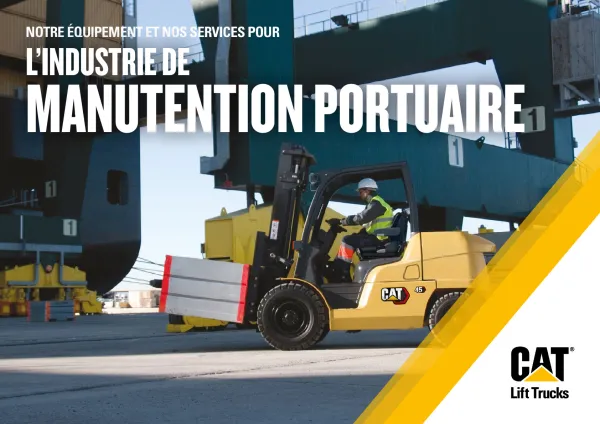
What can Cat® forklifts do for you?
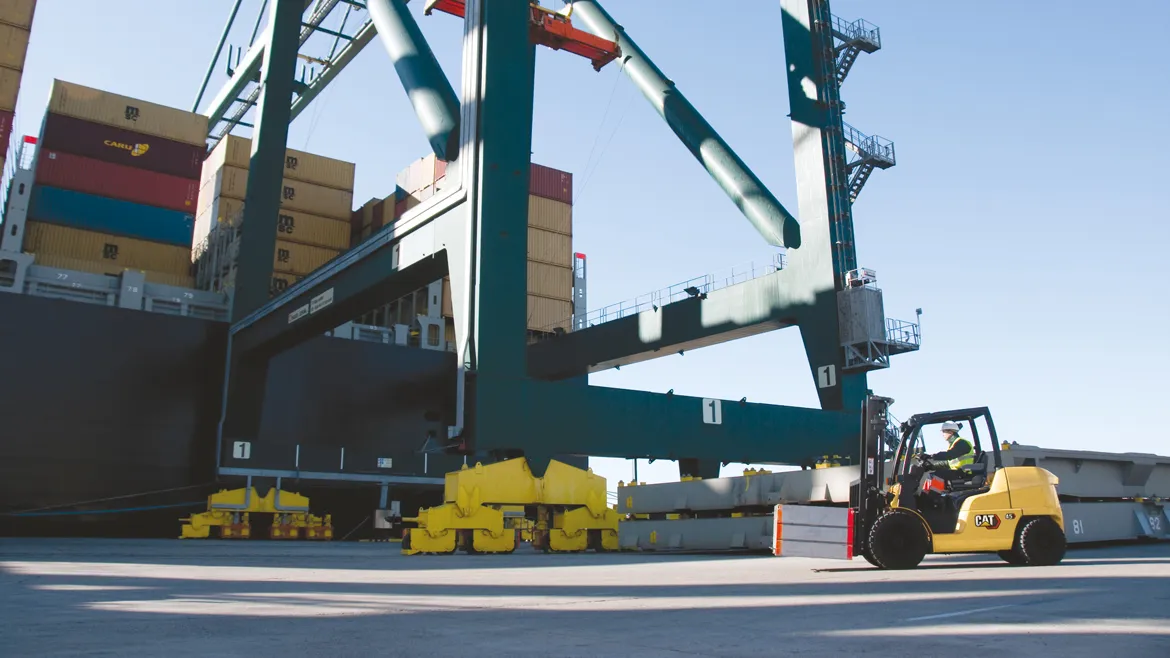
Cat® Lift Trucks and its dealers can offer comprehensive equipment supply and support for this internationally important industry. You’ll find Cat® forklifts working in seaports of all sizes, and in general or specialised terminals within those ports. They’re equally suited to loading and unloading cargo at inland terminals for transfer between different transport modes, including air, rail and road.
Some may be handling bulk cargo such as grain, coal or cement. Individual breakbulk cargo items, like machinery, might also be within their remit. Then there’s a large demand for lift trucks to fill and empty containers, lorries or other cargo spaces. They may be moving palletised goods on their forks or using clamps and other attachments specific to the type of load.
Goods received at ports aren’t necessarily moved on immediately. Often there are warehouses or other storage facilities on site or nearby. These require a variety of warehouse lift trucks. Here, port and stevedoring operations cross over with the world of warehousing and third-party logistics (3PL). That’s another sector which benefits greatly from our products and services.
At the port itself, the nature of a materials handling fleet will depend on the loads handled. We can supply small, medium-sized and large Cat forklifts suited to almost every application within our capacity range. This typically extends from 1.4 to 12.0 tonnes.
Of course, some loads handled in ports are much heavier than that. Some of our dealers supply and support extra-large and extra-heavy forklifts, reach stackers, container handlers and other specialised equipment from other premium brands. This brings the convenience of meeting all fleet needs from a single source. Ask your local Cat dealer.
Port and stevedoring industry challenges
24/7 productivity
Port activity never stops – and neither should your forklifts. Reliability is crucial. For drivers, working long and demanding shifts, lift truck comfort is essential too.
Time and tide
Fast turnarounds are vital, to keep the supply chain moving and avoid delay charges. Tidal restrictions on shipping movements may add extra urgency. Again, reliable forklift performance is key. To minimise downtime, you need tough, durable lift trucks with low maintenance requirements. They should be backed by quick, responsive service support to deal with any problems. They must perform quickly but smoothly and precisely, to maintain high work rates while avoiding accident-related time losses. Good vision, manoeuvrability, control and inbuilt safety aids all help in this respect.
Safety hazards
Ports are inherently hazardous environments. Busy, intense activity in cluttered and tight spaces, often with uneven surfaces, can lead to collisions and overturns. Heavy loads add to the hazards. Sturdy forklift construction and high stability are important, along with the safe qualities already mentioned.
Harsh environmental conditions
In coastal areas, salt air adds to the corrosive effect of wet weather on materials handling machinery. Forklifts must additionally withstand extremes of temperature, as well as dust and dirt. Working surfaces may be rough, potholed and slippery. Drivers, meanwhile, may face discomfort from heat, cold, noise, vibration and stress. Both workers and trucks need to be protected by environment-specific forklift designs and specifications.
Load variety and size
The sheer weight and bulk of the largest loads is an obvious challenge. Another is how to handle very different load types, changing from hour to hour. Depending on the mix of goods and the scale of the operation, the answer will be forklift specialisation or adaptability.
Financial pressures
To remain profitable, you must look carefully at all your forklift-related costs. Low materials handling output can lead to late fees and other performance-related penalties. Downtime for servicing and repairs may similarly reduce your work rate. Accidents not only slow down productivity but add the expense of damaged goods and equipment, clear-ups and compensation. When choosing forklifts, consider their total cost of operation. TCO can be reduced through durability, low maintenance needs and high fuel/energy economy.
Sustainability demands
The pressure from governments, customers and communities to make port operations more environmentally friendly is growing. Carbon emissions relating to forklift energy and fuel consumption are a big focus. Insufficiencies in the infrastructure supplying electricity to ports can be a limitation at present. On the other hand, increasing efficiencies in forklifts and their batteries allow fuller use of the supply available. In addition to efficiency, you should consider the longevity of your trucks and their components, as manufacturing of replacements has a heavy carbon cost too.
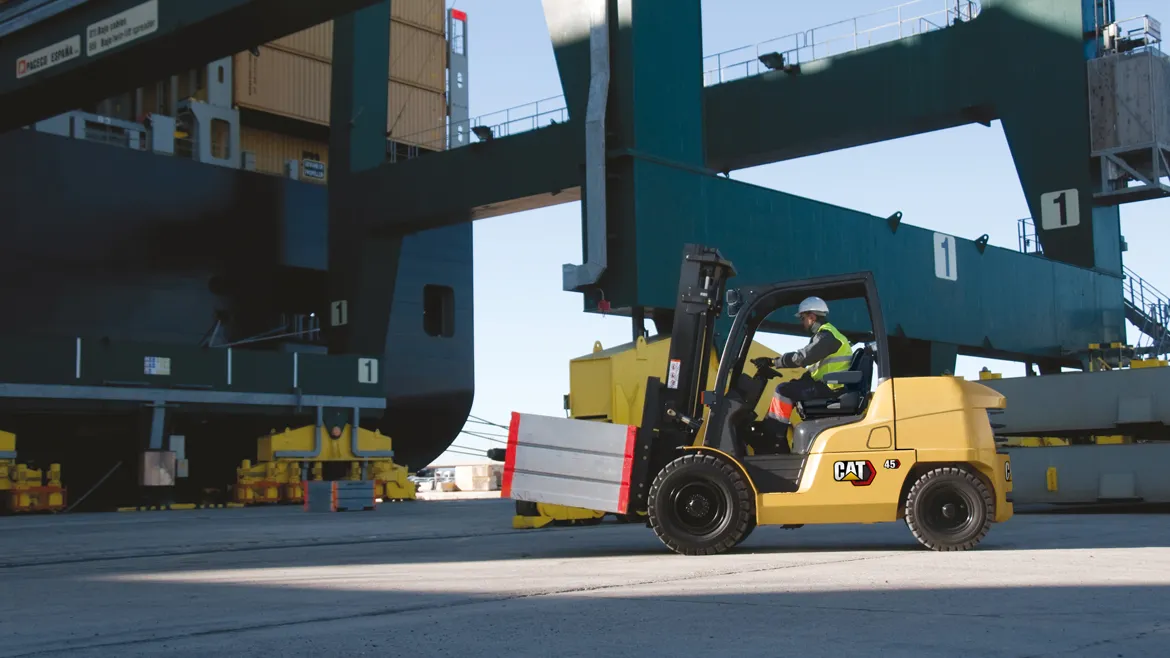
Materials handling solutions from Cat® Lift Trucks
Lift trucks for every role
Our comprehensive and well-proven range includes diesel counterbalance forklifts in capacities from 2.0 to 10.0 tonnes. We also have LPG models from 1.5 to 5.5 tonnes. Increasingly, electric counterbalance trucks are taking over in applications previously dominated by IC engine machines. Our electrics can match or beat diesel and LPG forklifts on power and performance. At the same time, they bring you extra electric advantages.
Cat electrics range from 1.4 to 12.0 tonnes in capacity. The smallest ones, including three-wheel models, are extremely compact and agile. Our higher-capacity electric ranges have larger wheelbases and tyres, for maximum stability and lifting ability. On our 6.0 to 12.0 tonne electrics, these factors – along with residual capacity – are enhanced by high-positioned mast cylinders. Whatever Cat truck you choose, you’ll find our mast and fork assemblies reliably robust.
Available adaptations include lowered-height versions, allowing even our 12.0 tonne electrics to work inside containers. Our forklifts can be fitted with forks of varying sizes and shapes to suit different load types. They can be adapted further using optional fork positioners or spreaders. Clamp attachments may be fitted where needed. These include, for instance, bale clamps and paper reel clamps. With four-way hydraulics, a single truck’s forks and attachments are quickly exchangeable to handle multiple load types.
If you need warehouse equipment, we have a full line-up including:
- Power pallet trucks
- Stackers
- Reach trucks - including four-way models
- Order pickers – low-level/2nd-level and medium/high-level
- Very narrow aisle (VNA) equipment such as man-up turret trucks or man-down VNA trucks
Quick, precise and safe materials handling
A combination of clear vision, agile manoeuvrability and smooth, precise control enables our forklifts to move and handle goods quickly – without collisions and breakages.
We minimise sight obstacles and adjust truck shapes to give unobstructed views in every direction. Take our 6.0 to 12.0 tonne electric range, for instance. Visibility through its mast is ‘best in class’. Its mast design allows the triplex stage to nest within the duplex, while the free lift cylinders are divided into two compact parts. The dashboard and overhead guard are also specially designed to maximise the driver’s view. A rear-view camera is fitted as standard. A variety of extra mirrors and cameras can be optionally specified on any of our forklifts.
Compact designs, easy steering and advanced control systems are other essential elements in making our trucks highly manoeuvrable. The exceptional agility of our 4.0 to 5.5 tonne 80V electrics, for example, gives drivers the feeling of driving a much smaller truck. It features dynamic aids including OmniTurn all-wheel steering, RDS (Responsive Drive System) and intelligent curve control.
A +100⁰ rear turning axle on these models enables instant side turns, with no need for initial backward movement. The truck can turn on the spot within its own dimensions. Similar abilities are found across the capacity ranges in our electric counterbalance product collection.
Engineering designed for careful, consistent control of varying loads is highlighted in our 4.0 to 5.5 tonne electrics. They feature SmoothFlow and other hydraulic technologies which optimise mast and fork movements according to load weights and lift heights. The result is smoother, faster, safer and more precise materials handling.
The hydraulic functions in our electric forklifts are controlled via light but responsive fingertip levers or, if you prefer, joysticks. They include a dual joystick option which separates functions such as clamp opening. This reduces the risk of accidentally releasing a clamped load.
To these features, we add effective braking technologies and automated safety aids for greater certainty. Examples include intelligent curve control, presence-detecting seat switches and automatic parking brakes. Comprehensive lighting options, including blue spots warning of the truck’s approach, ensure the driver can see and the forklift can be seen.
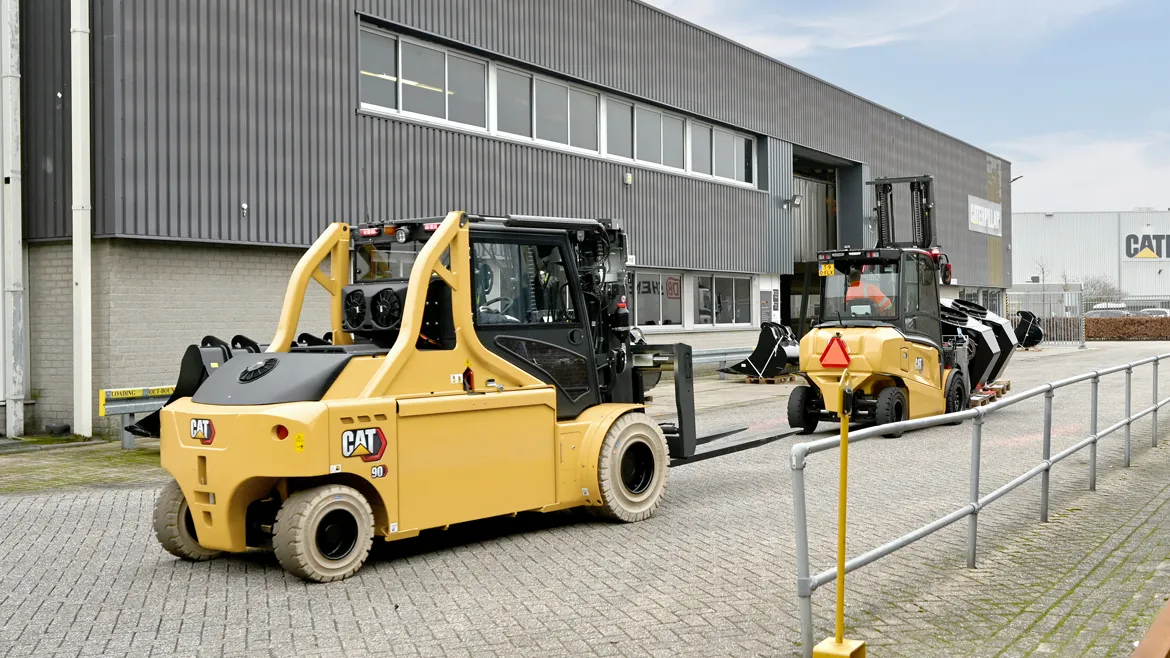
Forklifts fit for work – whatever the conditions
The world-famous durability and build quality of Cat lift trucks should give you confidence that they won’t let you down. Thanks to their reliable engineering, long component life and easy maintenance, they spend little time in the service bay. It means you can depend on them for virtually non-stop productivity.
The resilience of Cat IC engine forklifts to corrosion, water and mud has been proven over many years. To protect their engines from dust and dirt, our 1.5 to 3.5 and 4.0 to 5.5 tonne LPG and diesel trucks have high-positioned air intakes and enhanced filters. You can also choose optional dustproof kits. Options on the 4.0 to 5.5 tonne models include a belly plate shielding the truck undersurface.
On our electric forklifts, sealing of key components like electronic controllers and brakes against water, salt, dust and dirt is a priority.
Engineering and design for reliable temperature control in both our engines and our electric motors, in all conditions, is another important consideration. The heaviest-duty Cat 6.0 to 12.0 tonne electrics (NH models) have an additional rear oil cooler to cope with harsh use. In our 1.5 to 3.5 and 4.0 to 5.5 tonne LPG and diesel forklifts, strong cooling systems are standard. These can be supplemented with extra cooling options.
When our forklifts encounter uneven, bumpy or potholed working surfaces, their low centre of gravity and advanced control systems aid stability. This can be further enhanced through your choice of tyre type and by opting for dual tyres where appropriate. Our 4.0 to 5.5 tonne 80V electric range has electronic differential locking to maximise grip on slippery surfaces. This is also a standard or optional feature – depending on model – on our smaller electrics.
Optimum forklift driver performance
At Cat Lift Trucks we invest heavily in optimising the user experience given by our forklifts. The gains we make here by maintaining the condition and productivity of drivers are especially significant for those working intensively over many hours.
Weather protection is perhaps the most obvious measure to keep drivers comfortable. We will factory-fit or retrofit weatherproof cabins with heating, air conditioning and other comforts as required.
Noise and vibration can be annoying, even at relatively low levels. When someone is exposed to it hour after hour, day after day, it becomes a serious issue. It may leave them feeling tired, stressed and less fit for work. Our forklifts are designed to operate smoothly and quietly, with low vibration levels. This is especially true for our electric models.
Avoiding strains is another important step toward reducing tiredness and fatigue. Our trucks are designed around the driver’s needs, with ergonomics and comfort in mind. They allow the driver to adopt a relaxed, comfortable posture and to operate all controls with minimal movement and without straining.
Key features include high-comfort seating and armrests. These, along with the steering and other controls, are shaped for optimum anatomical support, and are adjustable to the perfect position for each operator. Easy all-round visibility is also important. Comfortable, spacious operating compartments with easy entry and exit are another part of the positive experience.
We believe forklift trucks should be enjoyable to drive and should empower their drivers to work well. Getting these factors right will give your drivers a sense of wellbeing and job satisfaction, which is good for your business too.
Environmental and financial sustainability
Advanced technologies have reduced fuel consumption in our LPG and diesel forklifts. Carbon reduction may also be reduced by up to 90% by replacing standard diesel fuel with HVO (hydrotreated vegetable oil). Meanwhile, continuous improvement in our electric forklift ranges has created the most energy-efficient and environmentally friendly solutions of all.
Our 4.0 to 5.5 tonne electrics are best in class in this respect. Their consumption can be lowered even further by selecting ECO mode and choosing the Li-ion battery option. The energy efficiency of our forklifts will continue to save you money over a long product lifetime, while reducing your environmental impact.
We contribute further to sustainability through the durability of our lift trucks and their components. It means less frequent replacement of trucks and worn parts, and therefore less energy and material consumption in manufacture.
Long life, low maintenance requirements and easy service access will also reduce ongoing costs and downtime. Looking ahead, the durable quality and inbuilt protection of Cat lift trucks will help maintain a high resale value.
Constant support from Cat lift truck dealers
Wherever you are, our dealers are ready and fully equipped to support you. Their deep understanding will ensure the perfect choice and combination of lift trucks for your application. What’s more, their mobile engineers will keep them working at peak performance through expert routine preventative maintenance and rapid response to any emergency. They have access to the fastest parts supply operation in the business.
One of the many advantages of Cat solutions is our common component strategy. High levels of component sharing between ranges maximise parts availability. This means much higher first-time fix rates, less downtime and lower related costs. By cutting the number of service-related journeys, we also shrink your carbon footprint even further.
Together, we and our dealers will ensure you have everything you need. Choose Cat forklifts and services for productive, efficient and cost-effective materials handling in the port and stevedoring industry.
Find Your Local Dealer
Your nearest Cat lift trucks dealer is equipped to provide maintenance services and help locate and supply the genuine parts you need.
Get started by selecting your region: