Forklift Types
From its basic principle, the forklift truck – or lift truck – has evolved into many different forms. Each design and configuration has specific benefits and abilities. In this way, forklifts have been developed to meet the needs of a wide range of industries. We offer the following forklift types:
- Counterbalance lift trucks
- Hand pallet trucks
- Electric powered pallet trucks
- Stackers – including telescopic fork stackers
- High-level and medium-level order pickers
- Low-level and second-level order pickers
- Reach trucks
- Four-way reach trucks
- Man-up turret trucks
- Man-down VNA trucks
- Tow trucks
We also have a range of entry-level warehouse equipment for smaller jobs.
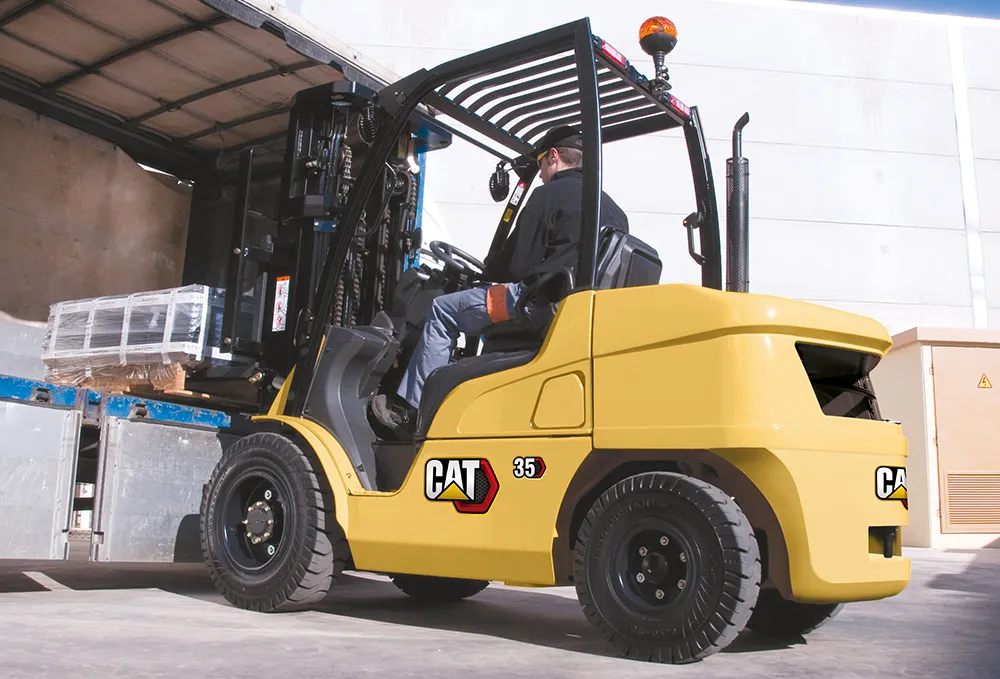
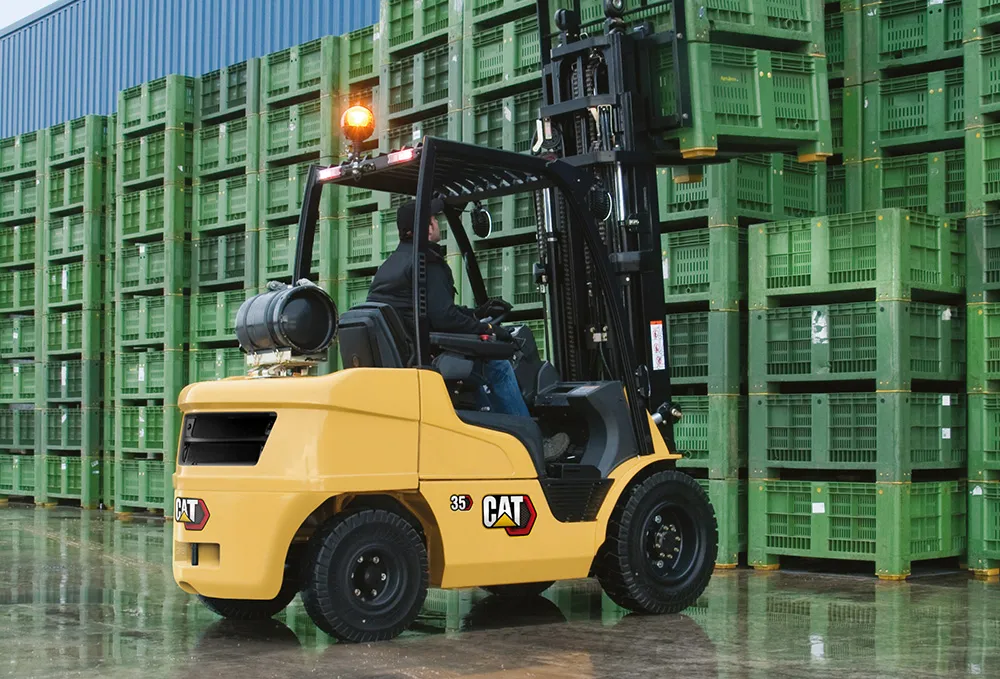
Counterbalance forklifts are probably the lift truck type that most people would find familiar. Their name comes from the heavy counterweight at the back of the truck. This gives the balance and stability needed for efficient heavy load lifting by the mast and forks at the front. You’ll find these trucks loading, unloading, stacking and transporting loads in a variety of storage, warehouse and distribution operations. They’re especially useful for stock transported on pallets. Their design makes it easy to drive up to the pallet’s exact location and insert the front-mounted forks.
Cat® electric, diesel and LPG counterbalance forklifts have earned a great reputation, over many years, for their quality, durability and performance. Today, the industry trend is very much toward electric power. However, we apply the same attention to meeting customer needs throughout both our electric and our IC engine portfolio. We have electric models with load capacities from 1.4 to 12.0 tonnes, equipped with the latest technology to maximise the advantages of electrification. Our LPG and diesel forklifts, with capacities from 1.5 to 23.0 tonnes, fulfil vital roles in applications where engine power is needed or preferred.
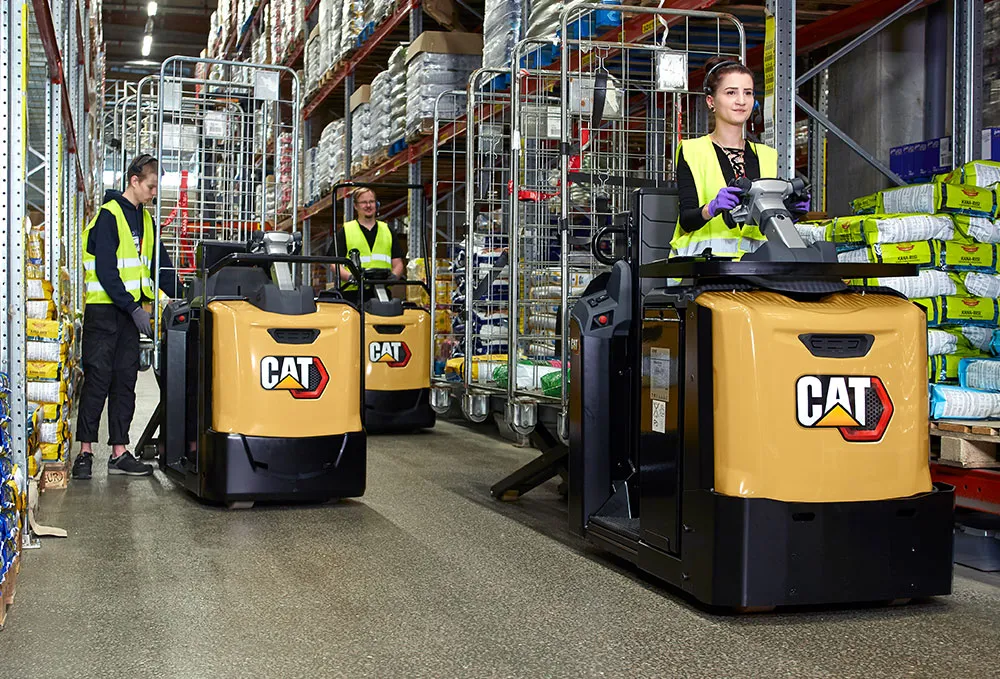
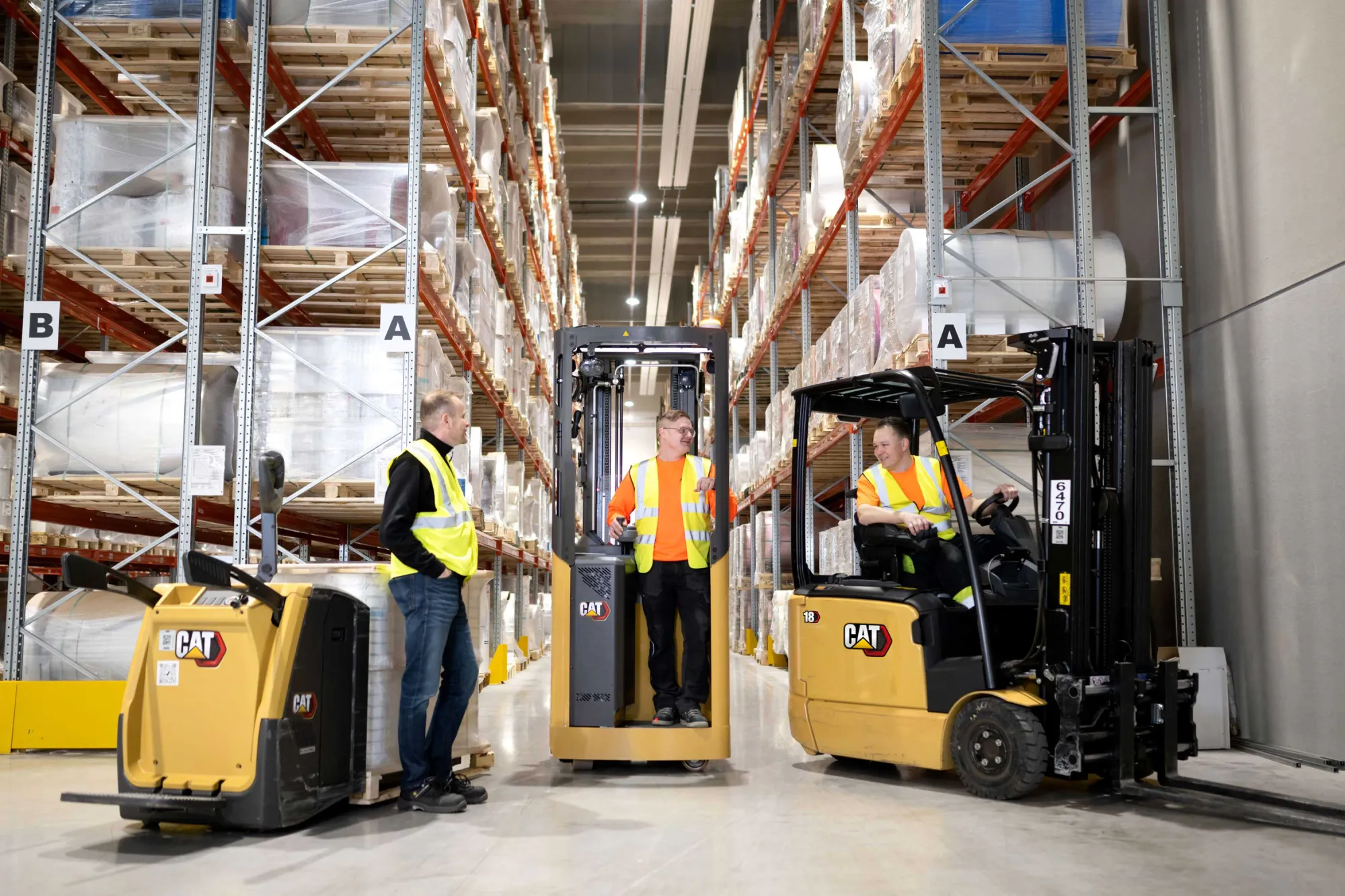
The term warehouse truck tends to mean all lift trucks that aren’t counterbalance forklifts. Warehouse lift truck and warehouse equipment are similar generalisations. You could think of a counterbalance truck as being a ‘traditional’ forklift, with forks at the front and a bulky counterweight at the back. Any lift truck that differs from that description is likely to be called a warehouse truck. And the variety seen in warehouse truck designs is enormous.
Of course, many counterbalance forklifts are also used in warehouses. This is particularly true for the smaller electric counterbalance trucks, including compact three-wheel models. Equally, warehouse trucks don’t just work in warehouses. They can be found in factories, shops and a multitude of other workplaces. They do tend to operate indoors though, rather than outside in yards. Often their workplace extends to the loading docks, ramps and inside lorries.
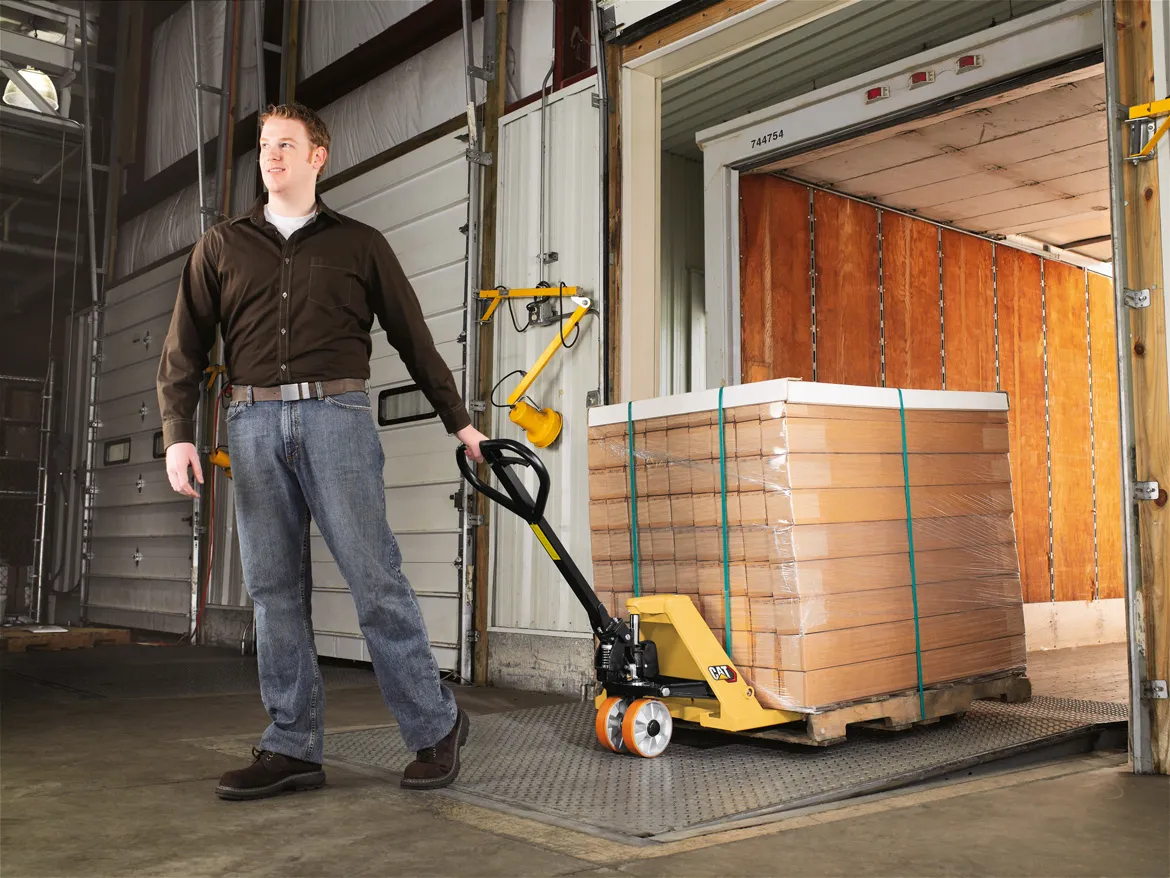
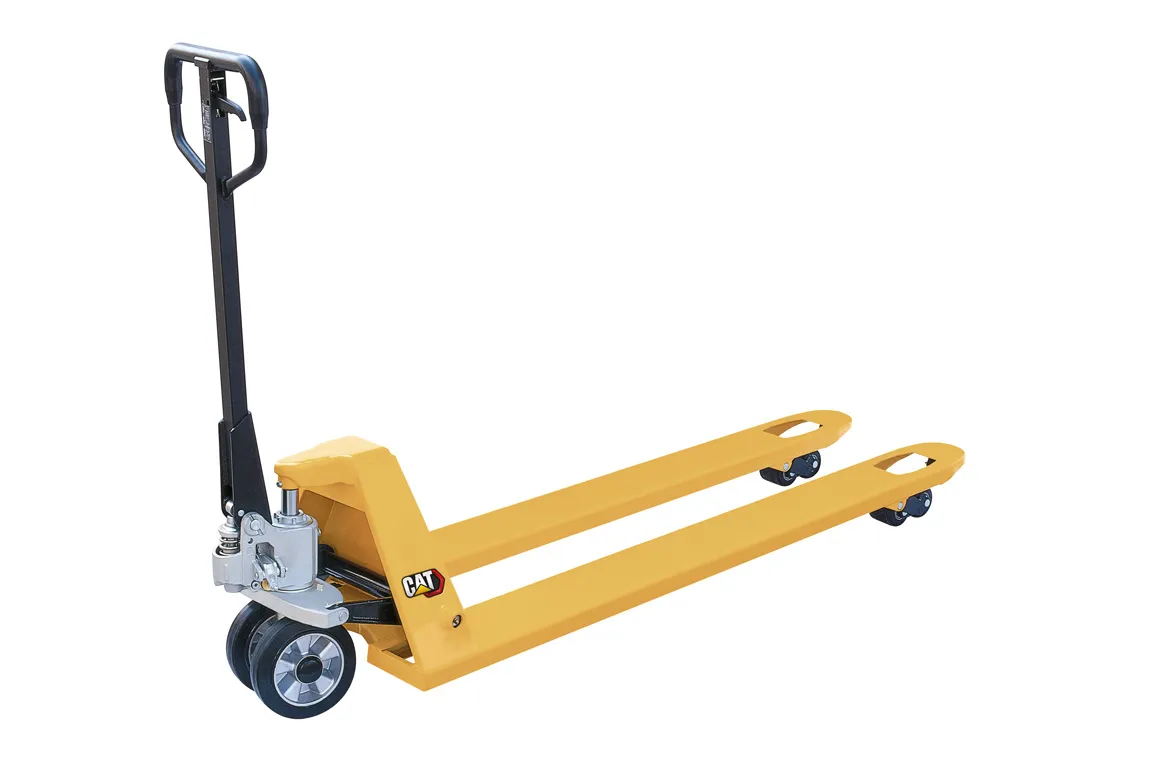
Compared to the other forklift types, a hand pallet truck may seem a very basic device. However, it still plays an essential part in many materials handling operations. Also known as a pallet jack or jigger, it’s used for horizontal transport of loads on pallets. Its small front wheels are mounted inside the end of the forks. Above the larger rear wheels, there’s a hydraulic jack, along with a tiller arm for control. To raise a load from the floor, so it can be moved, the user inserts the forks into the pallet and pumps the hydraulic jack. This lifts the forks above the front wheels.
There are multiple applications for this simple tool in warehouses, factories and other workplaces. You’re perhaps most likely to come across them in shops.
The Cat range of hand pallet trucks contains several models meeting different needs. Each has an impressive load capacity of 2.5 tonnes. Like all Cat products, they’re designed and built with ergonomics, manoeuvrability, durability and easy maintenance in mind.
Power pallet trucks do similar work to hand pallet trucks, but with the aid of electric lift and drive motors. This equips them to transport heavier loads, over longer distances and more intensive shifts. You may find them alternatively described as electric pallet trucks, powered pallet jacks, powered pallet trucks or just power pallets. Like hand pallets, they raise pallet loads a little above the floor and transport them horizontally across the workplace. You’ll find them everywhere from production areas to warehouses and cross-docks. As well as transporting goods internally, their duties often include vehicle loading and unloading. Light, small and highly manoeuvrable, they’re easy to operate on loading ramps, in lorries and in other tight spaces. They can also be used for order picking.
Our power pallet trucks bring you a wide choice of pedestrian, platform, stand-in and sit-on models. You’re sure to find one that’s perfect for your application. Their compact design, combined with powerful, fast and precisely controlled performance, maximises productivity. At the same time, their energy efficiency and low maintenance needs cut costs. We also prioritise ergonomics, comfort and safety.
Stacker trucks, otherwise known as pallet stackers or simply stackers, are amongst the most versatile of forklifts. At first glance they may look very similar to power pallet trucks – but look closer. A stacker has a mast, which power pallets don’t (except for double pallet handlers). It means that stackers can lift loads much higher. Compact, economical and adaptable, stackers are ideal for stacking, retrieval and horizontal transport of pallet loads in warehouses and racking systems. They may even be used for occasional order picking. Importantly, they can do these things in narrower aisles and smaller spaces than a counterbalance forklift or a reach truck.
Our extensive stacker range includes pedestrian, platform, stand-in and sit-on choices. Along with high power, speed and productivity, precise control and low running costs, they offer you improvements in storage efficiency. How? By allowing you to make your aisles narrower and your racking higher. For further flexibility, we have variants including initial lift, wide straddle and telescopic fork models. These add to the variety of standard specifications and optional features available to match your applications, challenges and conditions.
As its name suggests, an order picker truck is used for picking orders. It efficiently enables its operator to collect individual items, rather than whole pallet loads, from a racking system. Moving quickly between multiple locations in the racking, the operator gathers each item to fulfil a list of customer orders. Order pickers tend to work in warehouses with narrow aisles and high storage densities. Low-level and second-level order pickers are designed specifically for picking at the lower levels, from floor level upward. Medium-level and high-level order pickers are specialised for work at greater heights. Of all processes in materials handling and warehousing, order picking is one of the most time-consuming. That’s why efficient functionality is so important in order picker design.
High energy efficiency is a key advantage of our low-level order pickers. Ours are the most energy efficient in the market. They also make best use of the operator’s energy and effort, through their advanced technology, performance and ergonomics. Our second-level order pickers bring further choices, including a variety of additional optional features. Cat medium-level order pickers can reach picking locations up to 9.85 metres, while our high-level models go to 12.1 metres. Quick but smooth action, ergonomic aids and dependable safety mechanisms are especially important here. Whatever the order picking application, we have a model and configuration to suit.
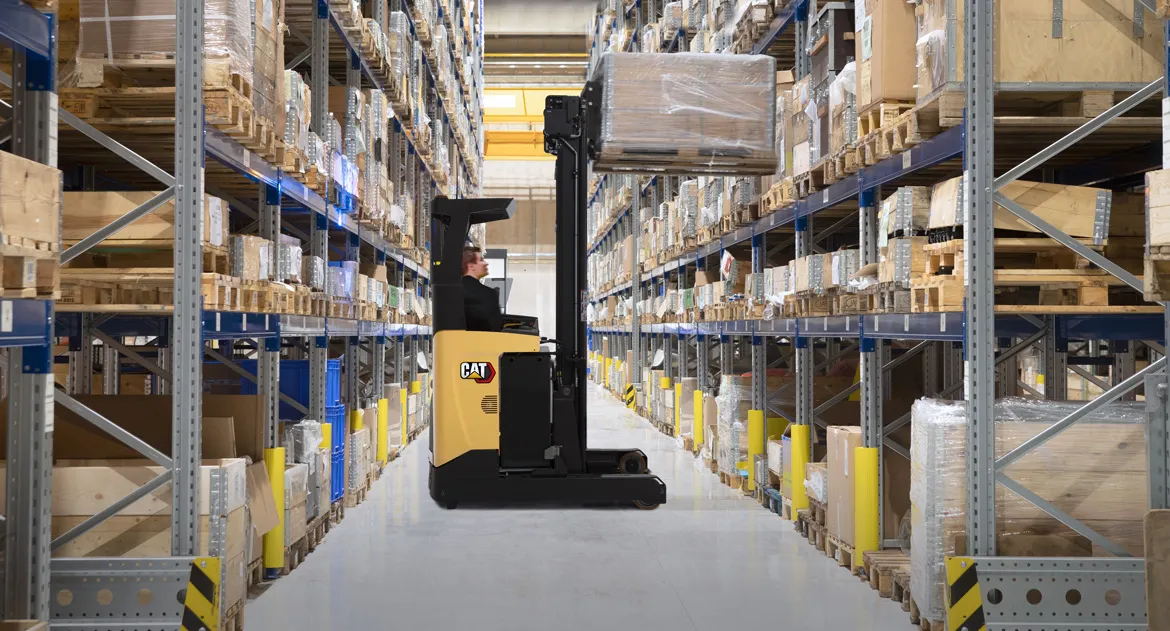
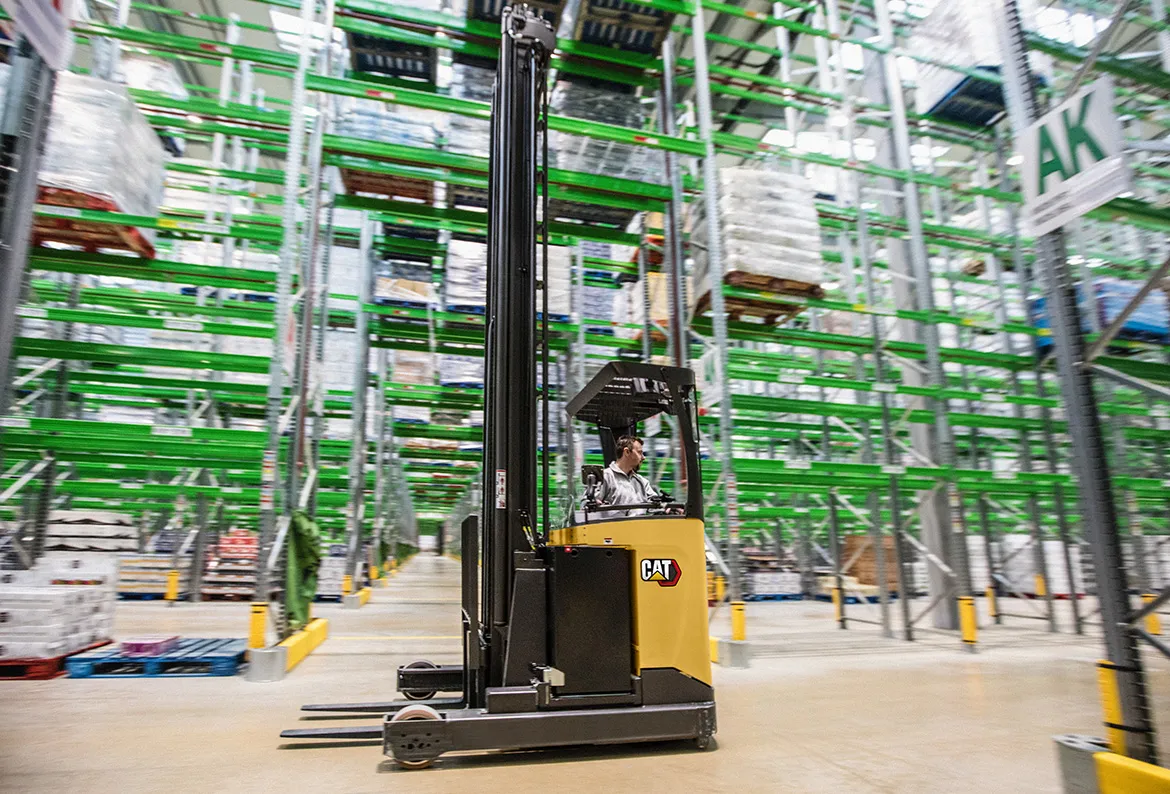
Reach trucks are a favourite choice of warehouse managers – especially when working with tall racking. They offer a compact footprint, great manoeuvrability in small spaces, and high lifting ability. Those factors enable efficient use of a building’s area and height for high-density storage of goods.
The defining feature of these trucks is their reach mechanism. It allows the mast to move forwards and backwards on the truck’s chassis. With the mast pulled back, the truck is short and easy to manoeuvre in warehouse aisles. Once the truck is positioned to stack or retrieve a pallet load, its mast reaches forward and its forks are pushed deep into the racking.
When retrieving goods, the mast is pulled back – bringing with it the forks and loaded pallet. The pallet and its load slide in between two robust support legs equipped with large wheels. These characteristic stabilising features help avoid the need for a large counterweight which would add to the truck’s length. The load is carried within the truck’s wheelbase, which maximises stability and minimises dimensions.
As well as reaching forwards and backwards, reach trucks are good at reaching upwards. Some can lift to 12 metres or more. Our reach trucks give high levels of power, performance and control – to get the job done quickly and safely. We also design them for supreme ergonomics and comfort – to get the best out of your driver.

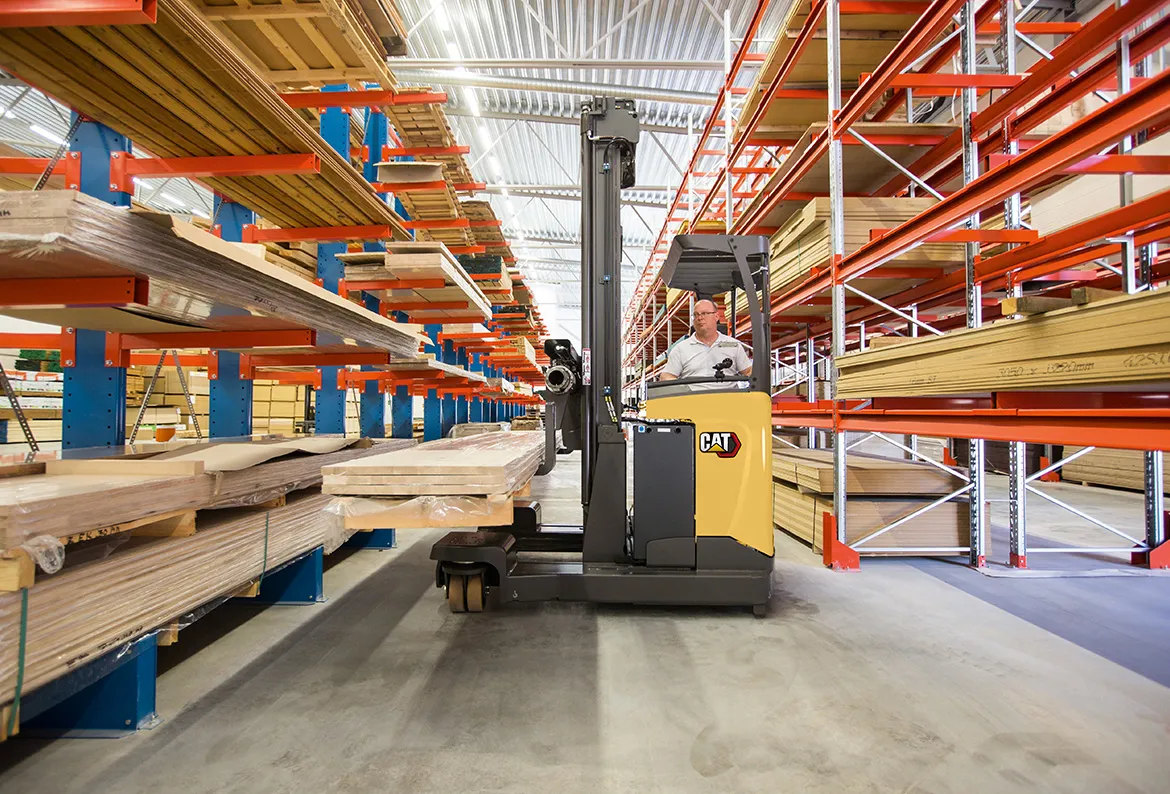
A four-way reach truck is specialised for handling very long items, such as pipes or timber, in narrow aisles. Equipped with a wide hydraulic fork spreader, our four-way reach trucks will also handle normal pallet loads. As their name suggests, these trucks can move forwards, backwards and from side to side. They can also rotate on the spot. This versatile motion is possible thanks to 360-degree synchronised steering. Our four-way reach trucks share the ergonomically advanced features and controlled performance characteristics of our other reach trucks.
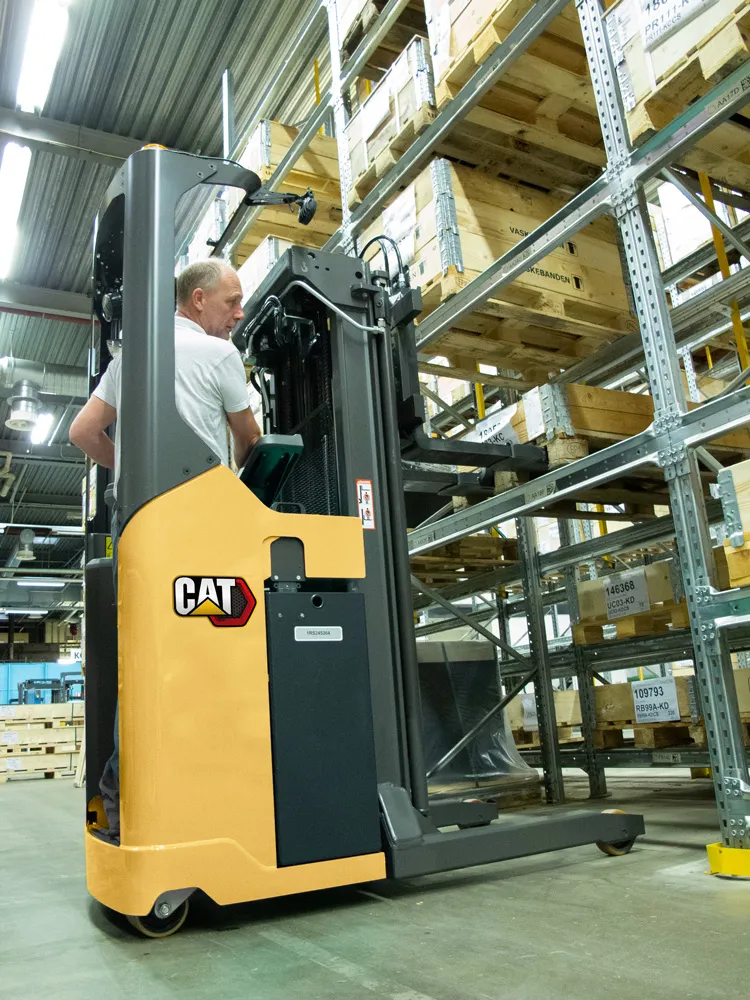
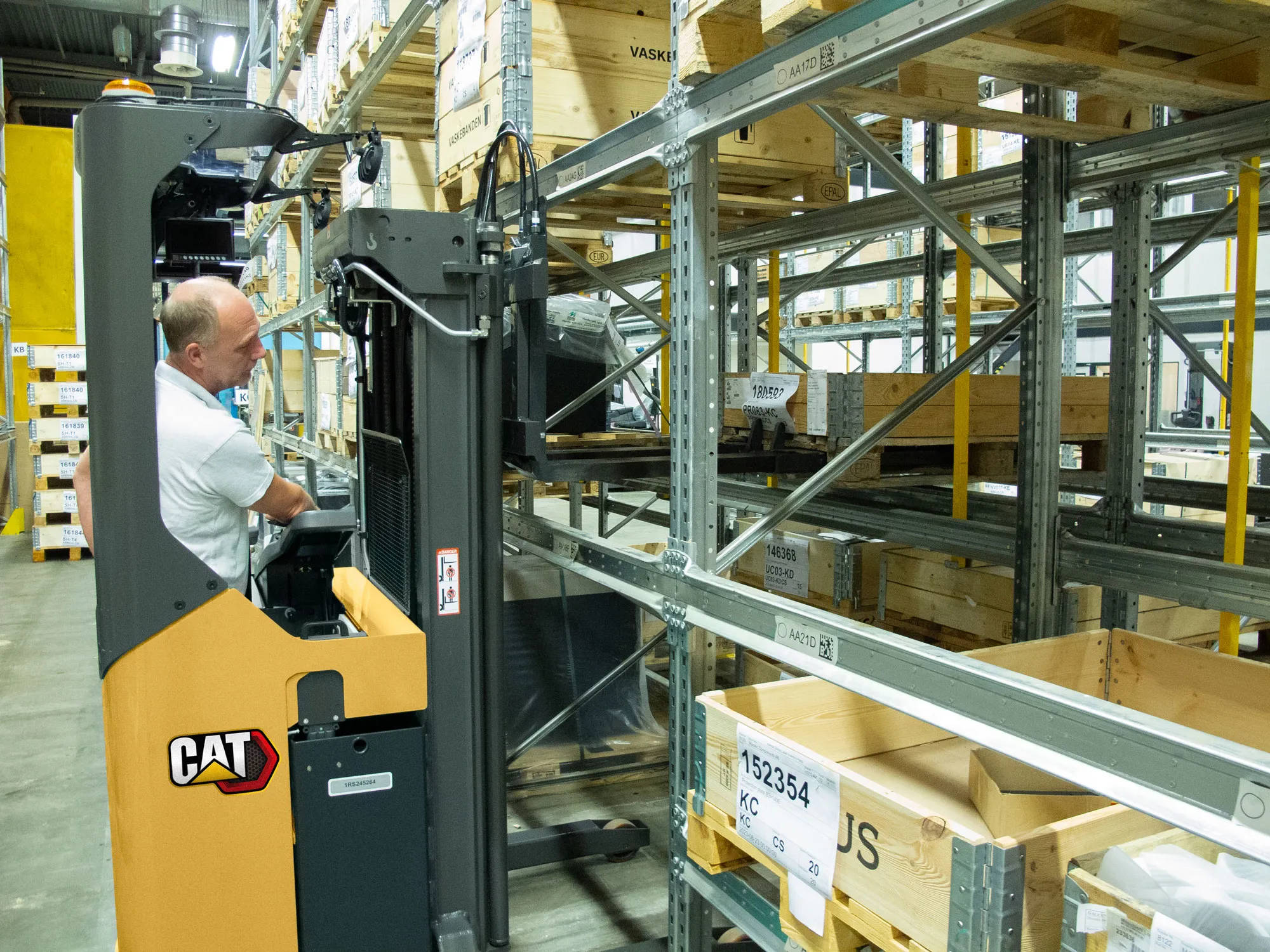
Our stand-in and sit-on stacker ranges each contain a telescopic fork (TF) model. These telescopic fork stackers are specialised for double-deep racking systems but also have many other uses. The double-deep storage approach substantially increases the capacity of a warehouse. That’s because only half as many aisles are needed. From each aisle, the telescopic forks can extend into the racking to stack and retrieve loads at two pallet depths. Additional uses may include handling long loads or reaching across lorry cargo areas. A versatile Cat stacker with telescopic forks can also act as a reach truck, a straddle stacker, a pallet truck and an order picker.
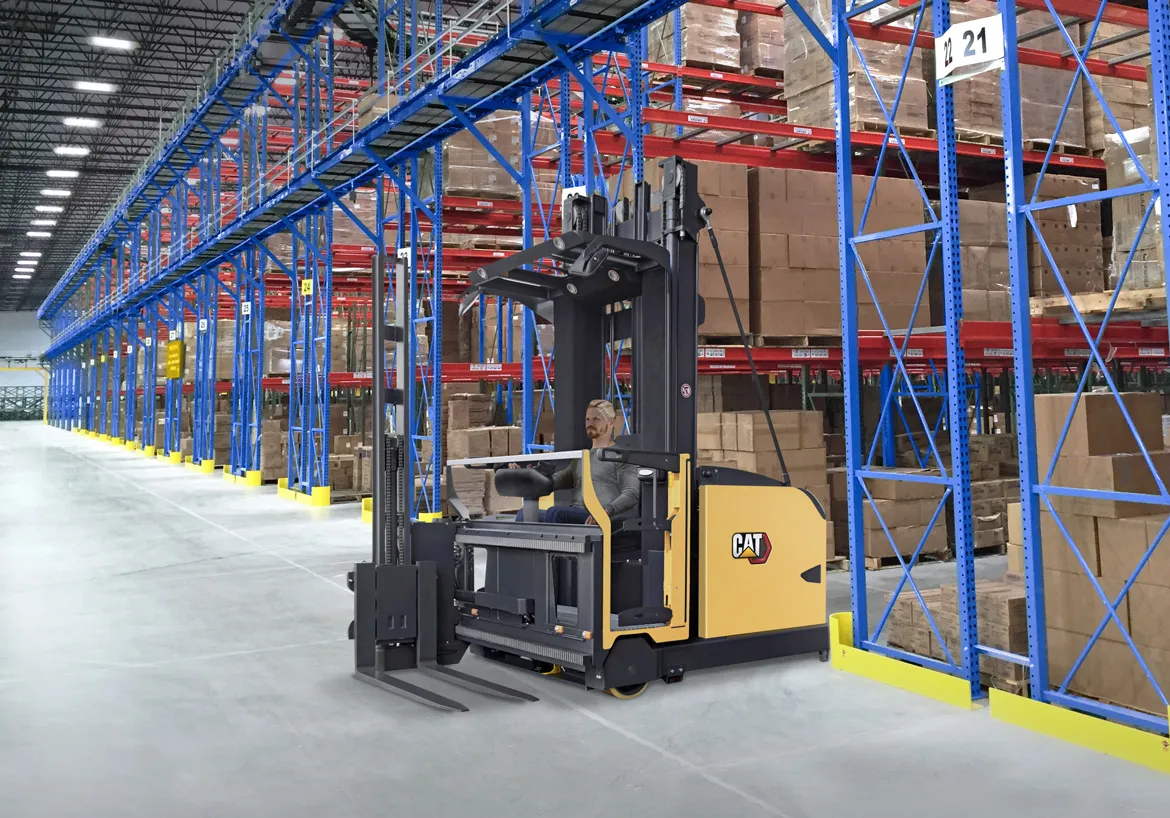
Man-up turret trucks are used for stacking and order picking in very narrow aisles (VNA) and high racking. The turret head, located in front of the operator compartment, has forks which slide sideways – along a rail – into the racking. The turret structure can be rotated to allow load handling on either side of the aisle, without having to turn the truck around. The operator cabin is raised and lowered, along with the turret structure, to give the user a clear view and easy reach to the stored goods.
Our man-up turret truck range covers lifting heights up to 19 metres and load capacities from 1.1 to 2.0 tonnes. Each is customisable to meet the customer’s space, load and operator needs precisely.
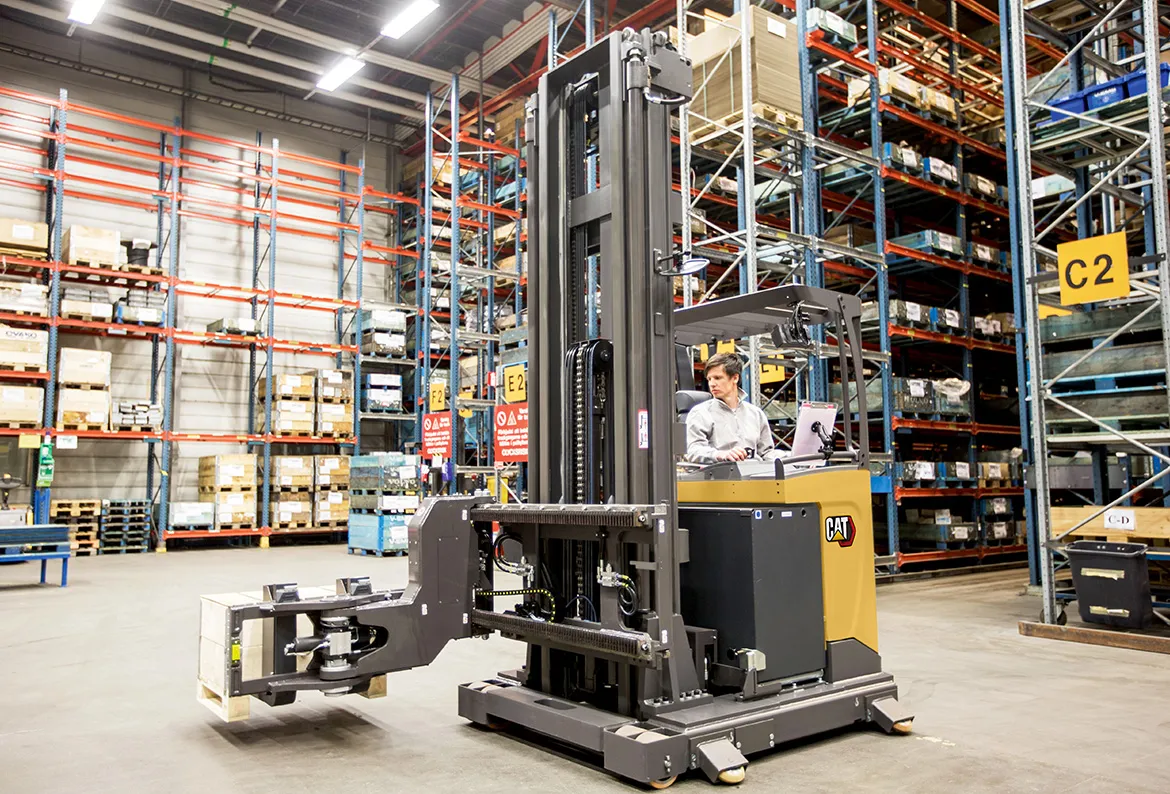
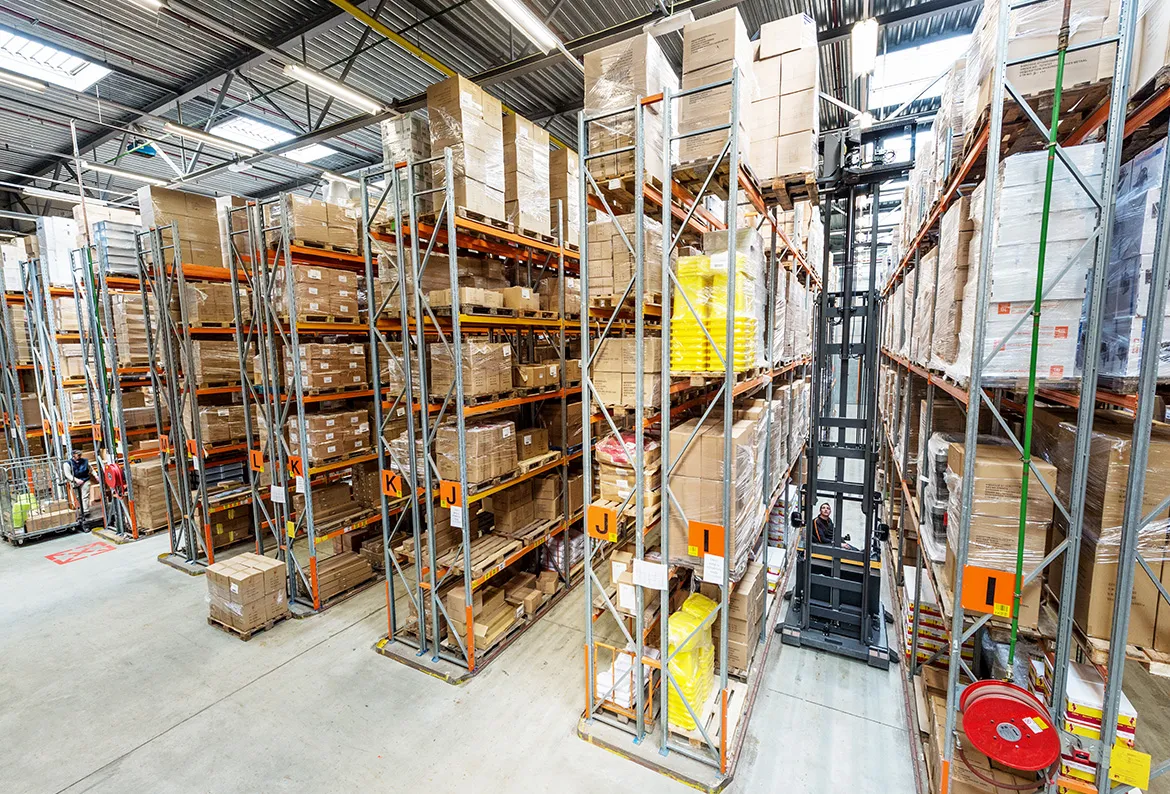
Our man-down VNA (very narrow aisle) trucks carry out a combination of tasks which would normally require more than one warehouse truck. Like turret trucks, they operate in very narrow aisles and use a swivelling reach fork assembly to handle pallets on either side. Their primary purposes here are pallet stacking and retrieval. However, they’re not confined to the aisles, as they can also be used outside the racking area. By transporting goods to and from the aisle ends, they reduce the need for additional trucks and drivers in the operation.
These man-down VNA models can optionally be used with wire or rail guidance equipment. This enables quick and safe operation in aisles little wider than the trucks. High standards of performance and ergonomic design, along with further optional aids, ensure optimum productivity.
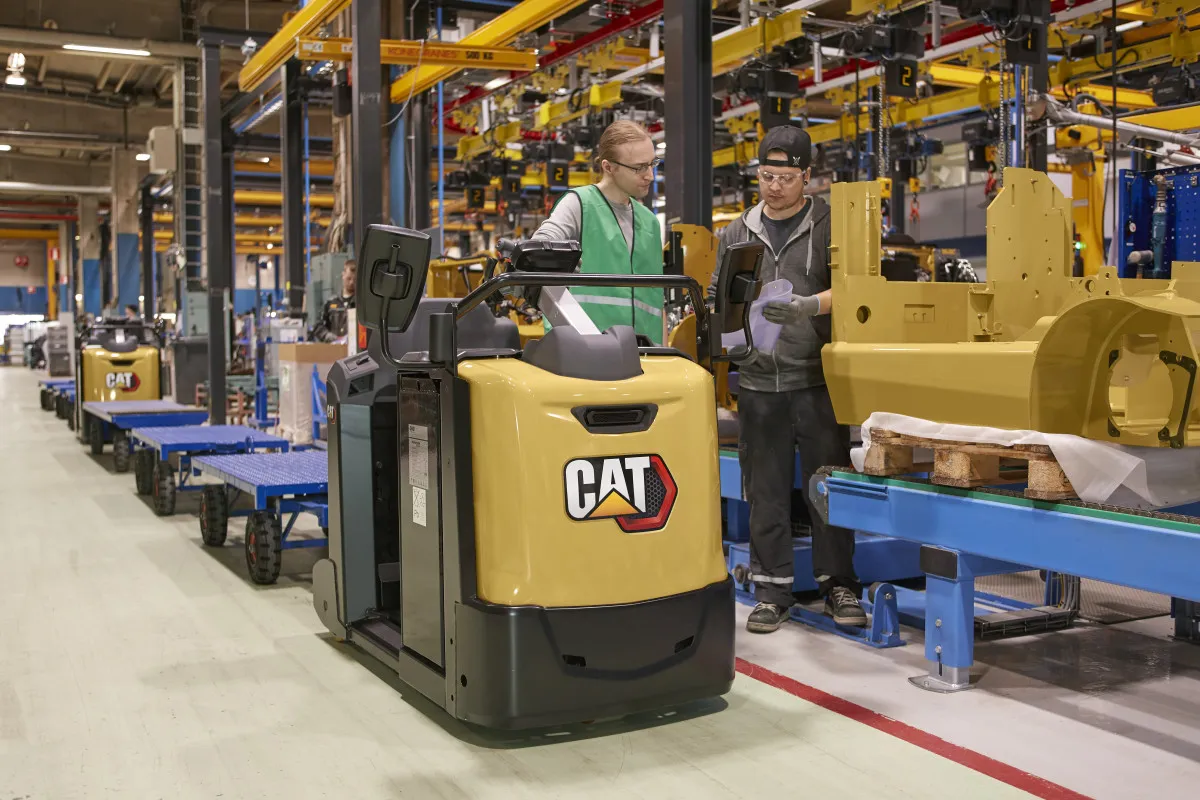
Tow trucks are designed to pull or tow heavy loads rather than lift them. Towing materials, components and goods in carts can be a very effective option in some applications. You’ll find tow trucks used in the automotive sector, for example, and in many other industrial and warehouse settings.
With no forks or lifting mechanism, a tow truck isn’t a lift truck or a forklift. However, you will see many similarities between our tow trucks and the low-level order pickers on which they are based. You can expect similarly high levels of energy efficiency, control, ergonomics and comfort. Our tow truck specifications include a variety of customisable and optional features to suit different towing operations.
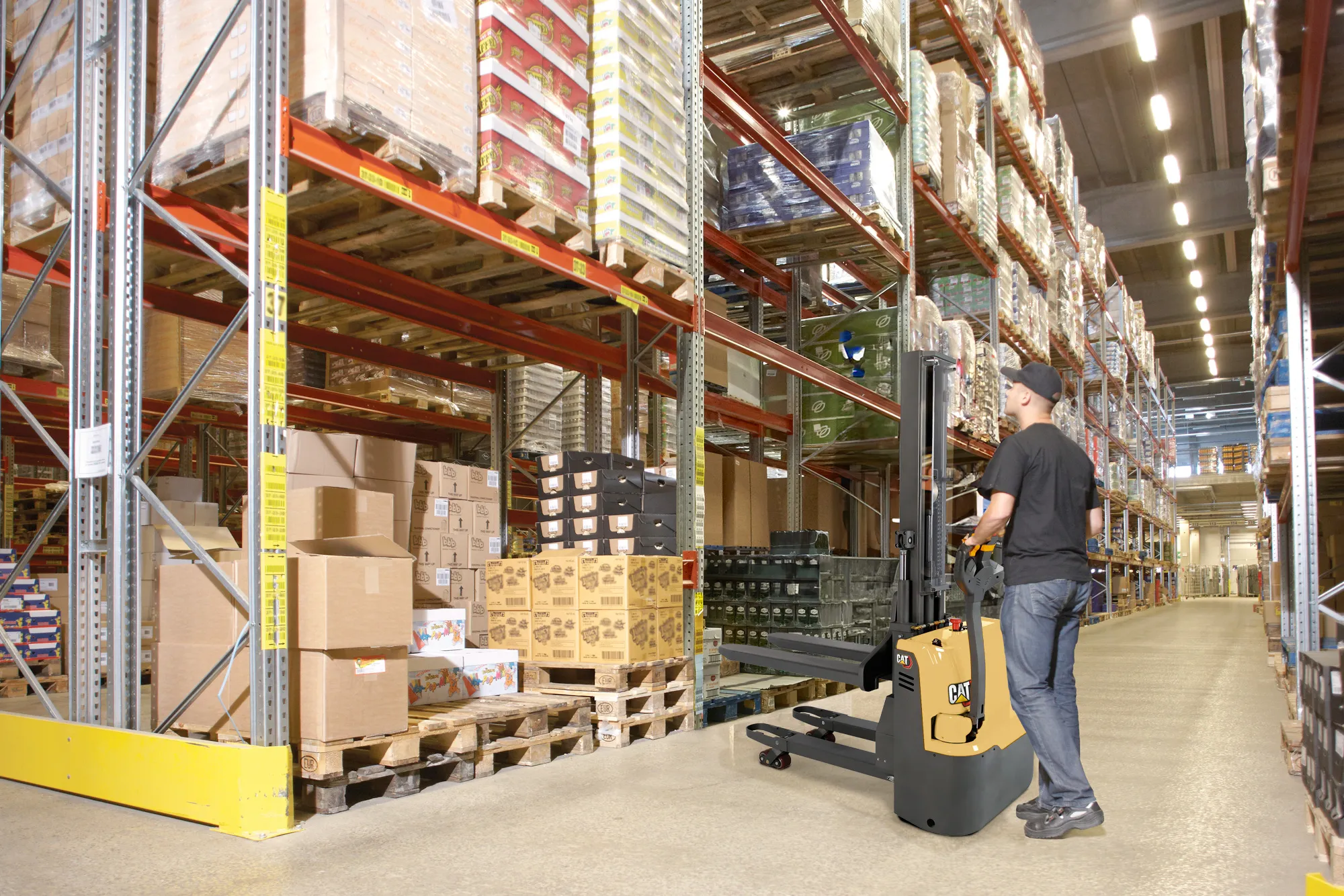
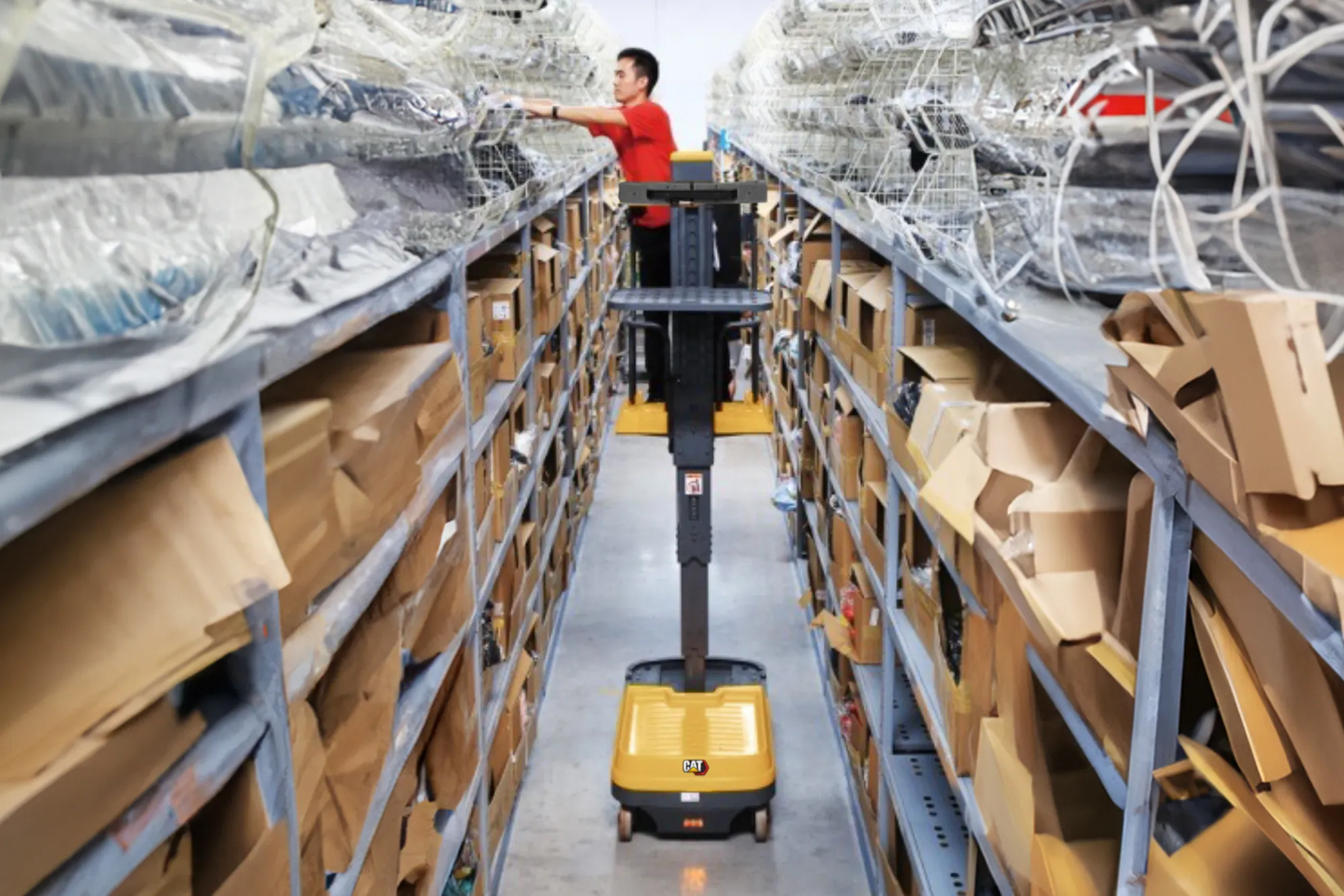
For lighter duties and smaller jobs, we have our EQ line of entry-level warehouse equipment. For more demanding applications, you should go for the high-performance warehouse trucks described in the FAQs above. Rest assured, our EQ line products have everything you need for dependable entry-level materials handling. That includes sturdy construction, simple maintenance, energy-efficient features, robust performance, user-friendly design, and safety.
The EQ line includes mini power pallets, conventional pedestrian and platform power pallets, compact stackers, sit-on tow trucks and a mini order picker. The mini order picker is perhaps the most unusual product. It’s not just for order picking: it does the job of a ladder too – but much more safely and efficiently.
Cat® Lift Truck dealer services
Our dealer network, refers to the official importers in each region that are committed to providing Cat products and support.
Cat lift truck dealers offer you:
- Cat values and qualities – including deep knowledge, excellent facilities and equipment, true customer care and powerful international support
- Optimised lift trucks – the whole Cat range, with each model matched perfectly to your needs
- Specialised technical support – from highly trained service engineers, fully equipped for rapid response
- Genuine Cat parts and service – with the industry’s fastest supply, for both current and older models
To find out about your nearest Cat® lift truck dealer, please visit our global dealer locator. Then select your country and language.
The best-equipped place to get your forklift truck repaired or serviced is your local Cat lift truck dealership. You can find the nearest one by visiting our global dealer locator.
Accessories and specialised attachments can be obtained through your Cat lift truck dealer.
To find out more about used Cat forklift trucks and who supplies them near you, please contact your local Cat lift truck dealer. Please visit our global dealer locator.
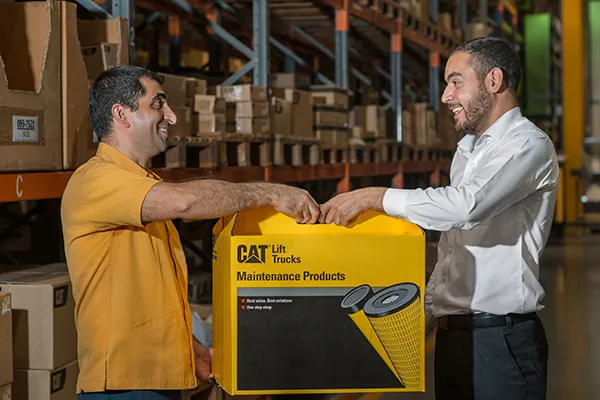
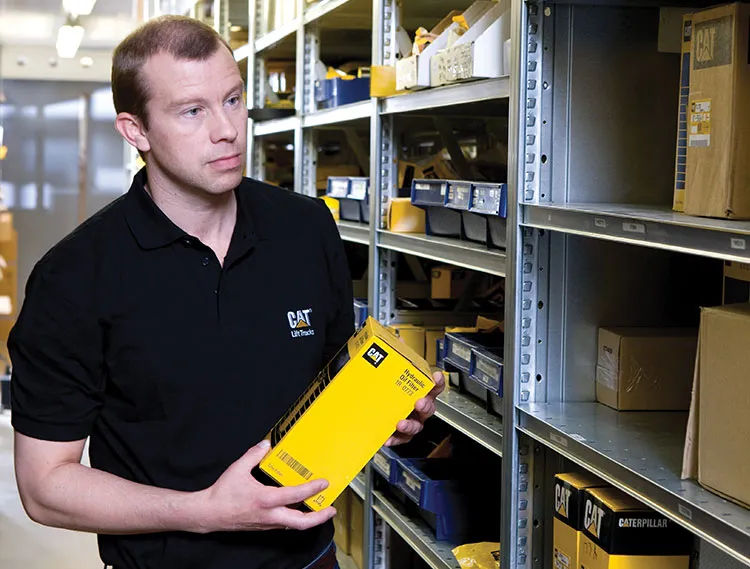
To find out more about original parts for Cat forklift trucks and who supplies them near to you, please contact your local Cat lift truck dealer. Please visit our global dealer locator.
To find out more about the financial solutions we offer, please contact your nearest Cat lift truck dealer or see our summary on financial solutions.
To find out more about our warranties, please visit the warranties section of this website. You can also contact your nearest dealer for their customised warranties package.
To find out more about lift truck driver training and other forms of training, please contact your local Cat lift truck dealer.
Practical advice on forklift-related issues
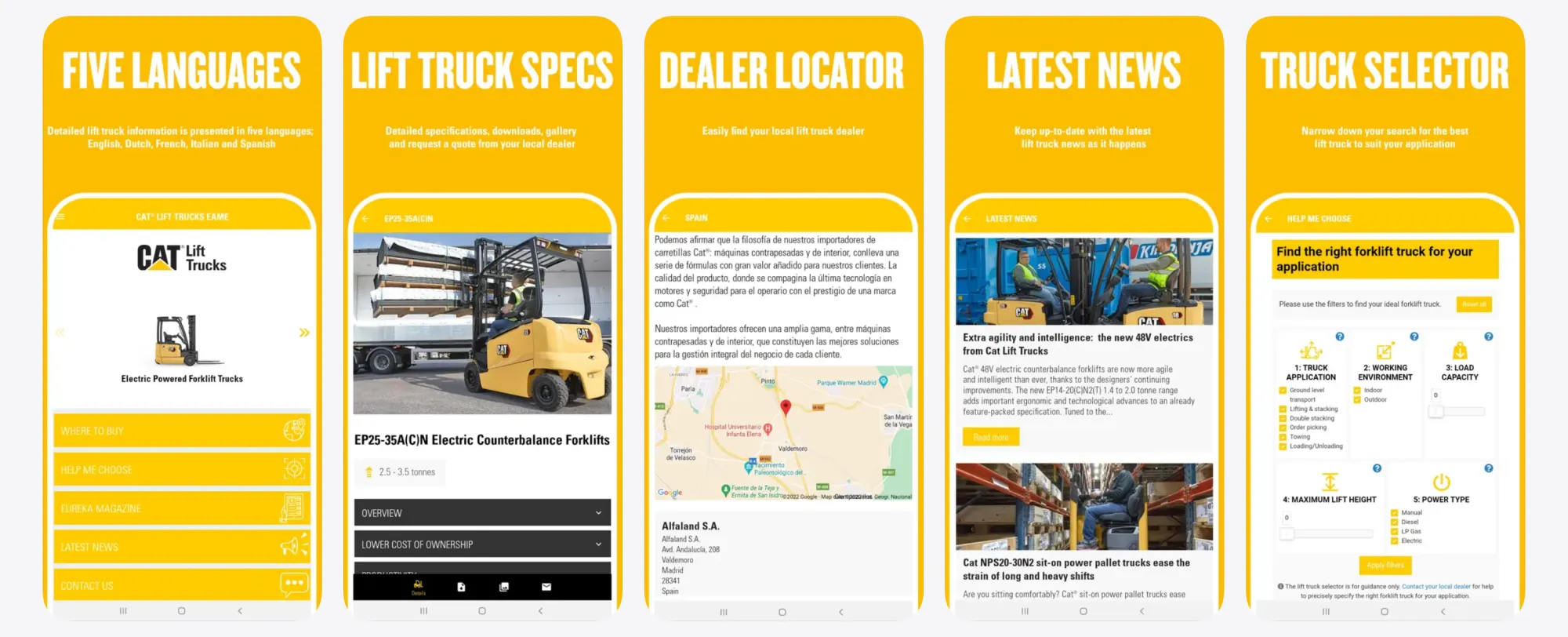
Why not download our free mobile APP? It contains detailed technical information and advice on our trucks, services and much more. You can also use it to find a dealer, make contact and submit queries.
Our blog is a good place to start. We explore a wide variety of relevant subjects in easily digested articles. We also offer straightforward, practical advice through Eureka Materials Handling Magazine.
Yes. We’re active on LinkedIn, Facebook and X (formerly Twitter). Follow us for the latest information and practical guidance.
The rated capacity of a lift truck tells you the maximum weight it can safely lift and transport under specified conditions. If your truck has a rating of 2 tonnes, for example, it will happily lift that weight to a height of, say, 2 metres. However, it may not be possible or safe to lift it several metres higher than that. The reduced maximum capacity available at a specific lift height is known as the residual capacity.
A lift truck salesperson should ensure that your chosen truck’s rated and residual capacities are suitable for your operation.
Specification of rated capacity depends on load centre distance. This is the horizontal distance between the load’s centre of gravity and the vertical face of the forks. If it’s longer than specified in the rating, stability is affected and capacity is reduced. Rating is also reduced if the mast is tilted. For lift trucks with mast attachments, further adjustments in rating are needed.
Forklift trucks are usually offered with a wide choice of masts. You should find mast tables in the specification sheets or other product literature for the forklift you are considering. Cat lift truck dealers will point you to the ideal mast choice, based on your application’s needs.
The height to which you need loads to be lifted, or from which you want to retrieve loads, is an obvious question. The mast configuration – simplex, duplex or triplex – is also important.
A simplex mast is a single-stage mast with a single channel. The mast and the mast carriage rise simultaneously.
A duplex mast is a two-stage mast with two channels. Its structure contains a simplex mast and a free lift cylinder. The free lift cylinder gives the first stage of mast extension. It raises the mast carriage to a certain height (depending on the mast chosen), and then the inner mast channel extends from there. When fully extended, the main lift cylinder raises the inner mast channels.
A triplex mast has three stages, with two inner mast channels and a free lift cylinder. You can achieve high maximum fork heights when needed, but keep the overall height of the forklift relatively small when the mast is lowered. In this way, a forklift used with high racking can also be used for low lifting in areas with restricted overhead clearance.
Your Cat materials handling dealer will be able to advise you on any maintenance or regulatory issues with regard to your forklift equipment.
Container specification simply refers to the forklift truck's ability to operate in standard shipping containers. The height of the mast and overhead guard are specified to allow operation within the container’s restricted height. Use of a full free lift mast allows loads to be lifted without extending the mast’s height above that limit.
Advice on forklift choice
Check out our Industry Solutions advice. We have guides summarising how our trucks and dealers meet the challenges of specific sectors. If yours isn’t mentioned there yet, don’t worry. We and our dealers have many years of experience in almost every industry that uses forklifts. Contact your local Cat lift truck dealer for further advice.
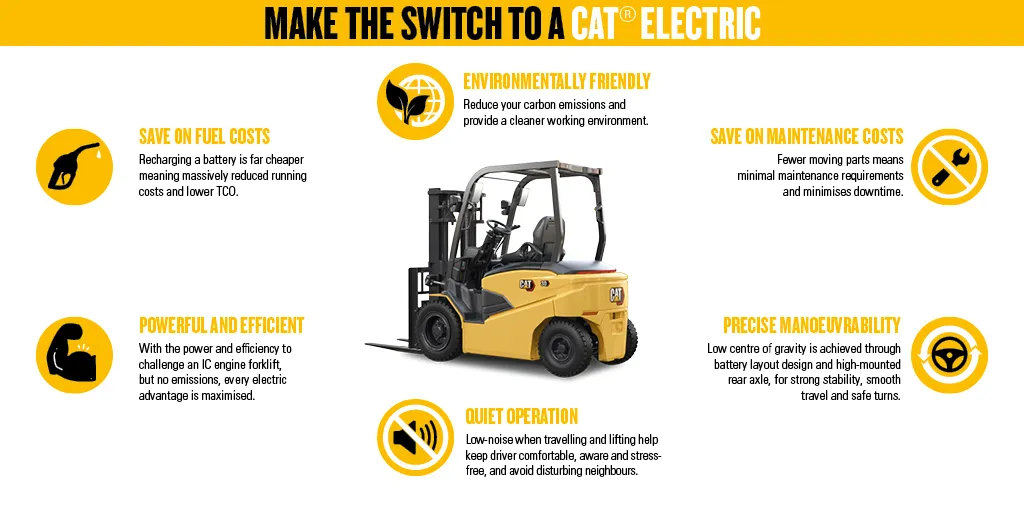
Today’s biggest materials handling trend is toward use of electric forklifts. These have many advantages over IC engine trucks.
See our summary of electric forklift advantages. But please note that we still offer a full range of high-quality Cat diesel forklifts and Cat LPG forklifts.
Your local Cat lift truck dealer will give impartial advice on power sources.
Try our online truck selector. This will help you to focus on suitable lift truck types and configurations. But please note that this is for initial guidance only. For precise specification of the ideal forklift, you should talk to your local Cat lift truck dealer.
Today’s main power source choices for counterbalance forklift trucks are IC engine (diesel or LPG) and battery electric (lead-acid or Li-ion). We and our dealers supply forklifts in all of these categories, so you can count on us for unbiased advice on the best choice. Visit our Power Sources page for more detailed information.
Electric powered counterbalance forklift trucks
There’s a clear trend toward electric counterbalance forklifts in today’s market. Our electrics can match diesel and LPG forklifts on strength and durability, while adding many electric advantages.
Electric counterbalance forklift advantages include zero emissions, higher energy efficiency, easier and more economical maintenance, long life and lasting value, powerful performance, intelligent control, programmability, safety, agility, supreme ergonomics and comfort, and lower TCO (total cost of operation).
You can choose between lithium-ion (Li-ion) and lead-acid battery power. A key advantage of Li-ion is the ability to use fast opportunity charging for non-stop productivity. Li-ion also gives longer battery lifespan, higher energy efficiency, longer runtime, and consistently high performance throughout shifts, with no daily maintenance and no gas or acid risks. Lead-acid batteries are still the best choice in many applications, and their technology continues to improve. Reasons for sticking with lead-acid may include familiarity, lower battery purchase price, lower set-up cost and high recyclability.
Diesel powered counterbalance forklift trucks
Diesel forklifts still contribute greatly to materials handling operations. They continue to improve in terms of emissions, although they are clearly best suited to outdoor applications. We are also seeing continued improvement in their fuel efficiency.
Their advantages include quick refuelling, compared to the charging times of electric forklifts. They can also be used in workplaces that aren’t connected to the electricity grid. There are space savings in terms of maintenance areas, as they don’t need battery rooms and charging facilities. Lower purchase prices are another attraction. As many years of experience have proved, diesel forklifts are resistant to the harshest of conditions. Some are left permanently exposed to the weather. Familiarity with their use, management and maintenance is a further reason for staying with diesel.
LPG powered counterbalance forklift trucks
LPG forklifts, powered by liquid petroleum gas, offer an interesting alternative. With lower emissions than diesel forklifts, they can be used in many indoor applications as well as outdoors. Their technology continues to advance, bringing higher fuel efficiency and cleaner, quieter operation.
Like diesel forklifts, they can be refuelled quickly – with no need for battery maintenance facilities and long charging periods. They’re ideal for remote locations without electricity grids, as gas bottles are relatively simple to deliver. Lower purchase prices, compared to electric forklifts, are another advantage. LPG forklifts are a well proven, durable, familiar and popular choice.
Each of the models featured on the website has a spec sheet. To access these please visit the Products section. Each Product has a Downloads section / Tab where you can download the Specification Sheet, available in over 10 languages.