
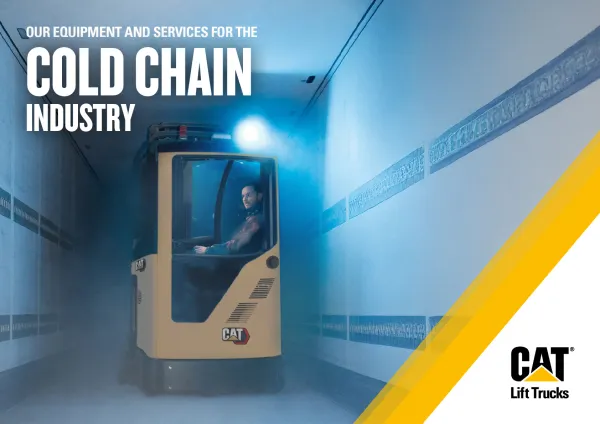
Download Cold Chain Industry Brochure
What can Cat® forklifts do for you?
We and our dealers have been providing application-matched lift trucks, services and expert advice to the cold chain sector for many years. We play a vital role in handling temperature-sensitive products through various stages of the cold supply chain. Our customers include businesses producing, storing and transporting:
- Food and beverages
- Pharmaceutical, medical and cosmetic products
- Chemicals
- High-tech materials
We have deep experience of cold store warehousing and, more broadly, the field of cold chain logistics. Our solutions include modified lift trucks for use at sub-zero temperatures in frozen warehouse and logistics operations. Temperatures in these may be as low as minus 35°C. We also support refrigerated or chilled supply chains, where temperatures are a little above freezing.
You will find Cat® counterbalance and warehouse trucks involved in:
- Loading and unloading vehicles between each stage of the cold chain
- Transporting cold materials and products from place to place in temperature-controlled factories, stores, warehouses and distribution centres
- Stacking and retrieving palletised loads
- Picking individual items to fulfil orders
Cold chain industry challenges
Forklift survival in an extreme environment
The cold supply chain needs to keep moving quickly, 24/7. Any stoppage in the chain, due to a forklift breakdown for instance, is expensive. It may also lead to product wastage through delayed delivery or slow transfer between temperature-controlled environments.
Lift truck dependability must be maintained despite harsh working conditions. Exposure to sub-zero temperatures can make some materials brittle. Affected items may include the trucks’ metal, rubber and plastic components. Metal structures shrink when cold, which accelerates component wear in some cases.
Even within a climate-controlled cabin, which is kept warm during operation, materials may become exposed between shifts. Seat and armrest covers, for example, are vulnerable.
Hydraulic and lubricant fluids can become thicker at cold temperatures. This slows down their response times and reduces their protection against wear.
Condensation is a major problem, especially when forklifts move between warmer and colder areas. Moisture accumulates on surfaces – and ice melts – when the truck warms above 0°C. On re-entering a sub-zero area, the liquid freezes. Ice inside components can damage them by expansion pressure, by seizing up mechanisms or by making materials brittle. Condensation and meltwater can corrode electrical equipment, connections, sensors and mechanical parts.
It should also be noted that extremely cold temperatures reduce battery capacity and runtime.
Materials handling time pressures and potential slip-ups
Perishable and urgently needed supplies must be moved rapidly through the cold chain. Transfers by lift truck between, say, refrigerated vehicles and cold stores, need to be fast enough to avoid unacceptable product temperature changes.
At the same time, accidents must be avoided. Collisions may cause costly damage to forklifts, facilities and products. For maximum economy, cold stores tend to have high storage densities, narrow aisles and tight spaces. These factors make lift truck manoeuvring more difficult and increase the chances of collisions.
Another risk is skidding, due to condensation and ice.
Productivity and availability of lift truck operators
Working in a cold environment can be uncomfortable and this may reduce the worker’s concentration. In these circumstances, performance suffers and accidents become more likely. The physical stress may cause fatigue and, over time, make workers more susceptible to illness.
Cold can also affect manual dexterity, making it hard for an operator to control a lift truck precisely. Wearing thick gloves solves the coldness problem but may add similar difficulty in operating truck controls. Bulky clothing, in general, limits the wearer’s mobility.
Within the relative comfort of an enclosed forklift cabin, vision is the sense that may be limited. Condensation and frost on windows and mirrors can obscure the driver’s view.
For many potential employees, the idea of working in chilly conditions is unattractive. The reality, for some people in cold store employment, is no better. Choosing the right lift trucks can help in attracting and retaining staff, by enhancing comfort, health, safety and job satisfaction.
Cold warehousing costs and efficiencies
Energy consumption is a major expense for the cold chain sector. Temperature maintenance in production and storage facilities is especially energy intensive. So, too, is materials handling. The differences in energy efficiency between electric forklift choices need to be carefully considered.
Storage space is another important consideration. It’s expensive to buy or hire and expensive to refrigerate. The right forklift choices can help maximise your stock density and minimise the space and aisle width needed for manoeuvring. In addition, their precise control can avoid collisions and spillages.
Forklift productivity and dependability are needed to prevent supply chain delays and product spoilage. You should also look at the time taken – and costs – for lift truck maintenance.
Sustainable cold chain logistics
Like all industries today, the cold chain sector’s sustainability is under scrutiny from customers and legislators. Carbon emissions, energy consumption and waste avoidance are high priorities.
Materials handling solutions from Cat® Lift Trucks
Sub-zero forklifts
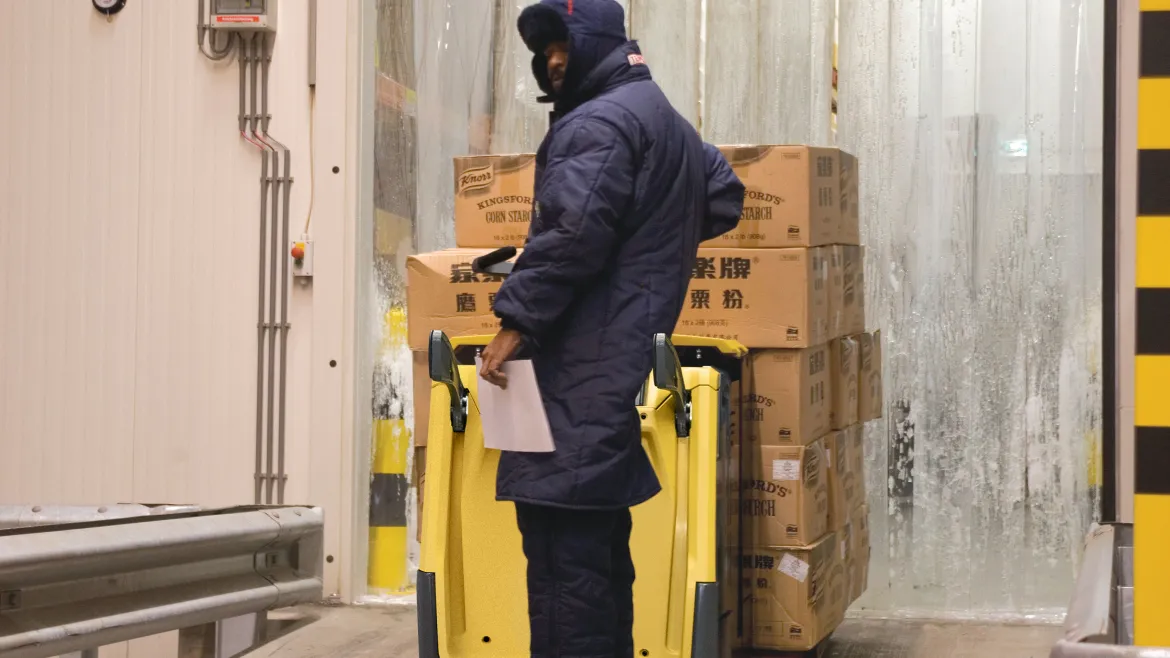
Cat lift trucks are famously durable and dependable. In both our counterbalance and our warehouse ranges, we seal key components against water. Little or no modification is needed for temperatures down to 0°C.
For work in sub-zero conditions, we have specially modified versions. Cat 1.4 to 2.0 tonne (3-wheel and 4-wheel) electric counterbalance forklifts, for example, can be adapted for temperatures down to minus 35⁰C. The same applies to our pedestrian power pallets, pedestrian stackers and low-level order pickers. Most Cat warehouse products can be optionally modified for conditions down to minus 30⁰C.
The following modifications on our reach trucks will help to illustrate what’s needed:
- High-quality stainless steel and welding, especially for critical components such as axles
- Cold store hydraulic fluids and lubricants
- Additional grease nipples
- Extra sealing of electronics and wiring, including filling of connectors with specialised lubricant
- Sealed, insulated and heated controllers and displays
- Specialised rust protection treatment on unpainted surfaces, including screw heads, load and drive wheel hubs, bolts securing drive motor, gearbox, mast and chassis, and any other exposed features and components
- Crack-resistant PVC seat and armrest covers
High-capacity batteries are needed in cold stores to offset the runtime-limiting effects of extremely low temperatures.
In addition to robust and reliable lift trucks, our dealers offer expert preventative maintenance packages and rapid response from mobile technicians. We keep your forklifts moving, whatever the conditions.
Fast but safely controlled materials handling
As you would expect, all Cat electric counterbalance forklifts and Cat warehouse trucks offer powerful motors and fast performance. However, maximising productivity isn’t just about achieving high travel and lifting speeds. It also requires ergonomics, vision, manoeuvrability, precision and control. These factors enable optimum speed while avoiding spills and accidents.
On Cat electric counterbalance forklifts, our Responsive Drive System (RDS) helps ensure that all travel and hydraulic actions are smoothly controlled. Advanced cornering control systems are a further aid in optimum matching of speed to circumstances. In addition, there are hydraulic technologies which optimise mast and fork movements according to load weights and lift heights.
These trucks also feature four-wheel steering systems, with +100⁰ rear turning axles, for precise agility. Alternatively, on the 3-wheel electrics, optional 360⁰ steering enables fluid turns without changing direction. It also allows faster turning without destabilising the load.
Cat warehouse trucks are similarly engineered and designed for fast but controlled performance. Our reach trucks, for instance, feature advanced drive, cornering and hydraulic control systems to maintain optimum speed and smoothness in all motion. They also offer the option of 360⁰ steering.
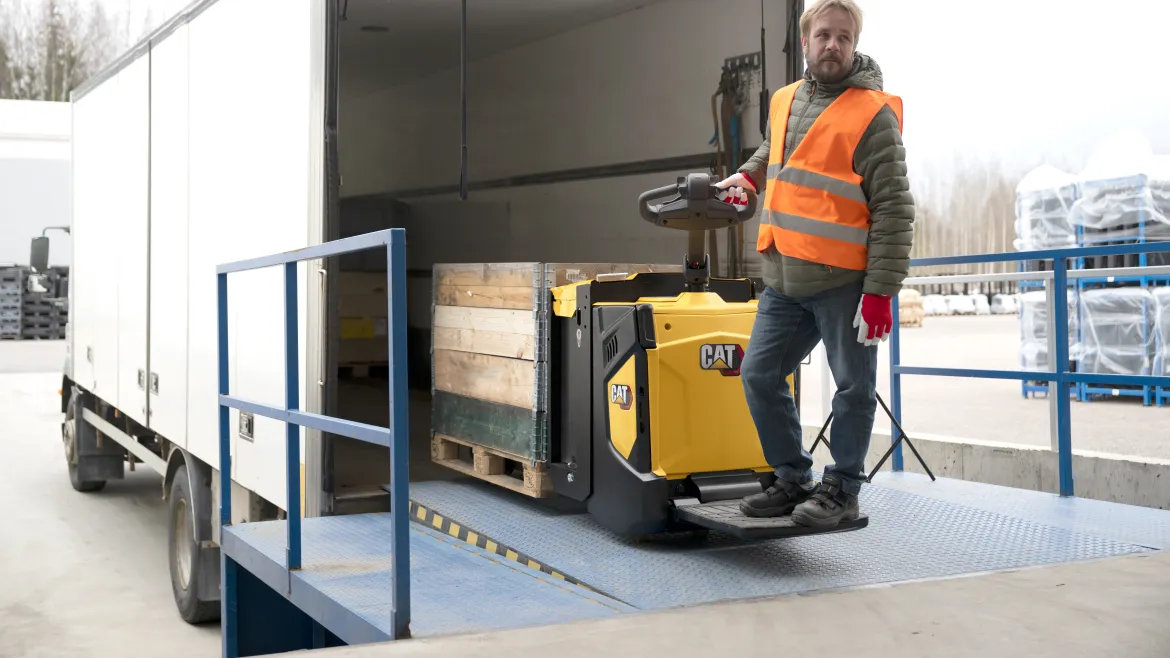
Our power pallet trucks and stackers come in pedestrian, platform, stand-in and sit-on ranges. You can carry the smaller power pallets in the back of a refrigerated goods vehicle for quick and easy loading and unloading at any destination. Further choices include platform double pallet handlers, which can double the rate of load movement.
Cat stand-in power pallets and sit-on power pallets, stand-in stackers and sit-on stackers, offer an interesting upgrade from platform models. With more compact dimensions, greater operator enclosure and protection, and advanced drive, steering and stability systems, they can work faster. Their features include automatic cornering control and optional 360⁰ steering.
Our designers apply the same care and attention to our other product groups, including:
- Order pickers – low/second-level and medium/high-level
- Tow trucks
- Man-up turret trucks
- Man-down VNA trucks
For extra confidence on icy, wet or mixed surfaces, we can fit special tyres to improve traction. On our reach trucks, these tend to be Tractothan® 93°shore or Super Grip 94°shore. Our electric counterbalance forklifts offer electronic differential locking – standard or optional, depending on model – to maximise grip on slippery surfaces.
Cat platform power pallet trucks and stackers have the option of Active Spin Reduction (ASR). This reduces drive wheel spin and wheel wear on slippery floors. ASR is also optionally available on Cat reach trucks and man-down VNA trucks.
For our platform power pallets, we have developed the revolutionary ProRide+ system. This simultaneously maintains traction, damping and stability, even on wet or irregular surfaces or when cornering.
On our electric counterbalance and reach trucks, especially, automated aids to smooth performance and optimum speed also help to avoid slips.
A positive and productive lift truck user experience
For maximum driver comfort, morale and productivity in long, cold shifts, heated lift truck cabins are a must. To ensure safe all-round vision, these should have large windows, with heating to clear mist and ice, and clear rear-view mirrors.
The optional cold store cabin on Cat reach trucks is a good example. Its features include:
- Large glass area and integrated mirrors for excellent visibility
- Automatic climate control, adjustable from 18 to 28°C, with a rapid ‘HI’ boost for fast heating at the start of a shift
- 14 ventilation outlets, ensuring even heat distribution
- Stepless fresh air intake and recirculation controls, to prevent misting while maintaining healthy oxygen levels
- Interior design with no cold surfaces in operator contact areas
Similar features can be found in our electric counterbalance comfort cabins. With the benefits of heating, drivers don’t need bulky and mobility-limiting cold-weather clothing.
In applications requiring pedestrian or platform power pallets or stackers, heated cabins aren’t an option. Precise control of such tiller-operated trucks can be difficult when wearing thick gloves. We’ve overcome that problem with our class-leading, ergonomic emPower tiller head. Its design includes a comfortable grip, large, easy-to-reach controls, and freedom of movement for large or thickly gloved hands.
We at Cat Lift Trucks are leaders in the field of optimising ergonomics and user experience. We put lift truck operators and their needs at the very centre of our designs. Our ergonomic forklifts don’t just protect users from discomfort and ill-health due to fatigue, strain, vibration and noise. They make work a satisfying and enjoyable experience.
Our electric counterbalance forklifts, for instance, give drivers a comfortable, spacious operating compartment – with the option of a heated cabin of course. All controls are user-friendly. Entry and exit are quick and easy. Ride quality is smooth and quiet, with low vibration levels.
Our 1.6 to 2.5 tonne reach trucks are an illustration of perfect forklift ergonomics. They’re ideal for workers who spend long hours in the driving seat. The tilting seat, the right and left armrests and even the floor height are adjustable to fit each user perfectly. Palm Steering, mounted on the left armrest, allows manoeuvring with minimal effort or movement, from a relaxed body position. A multifunctional joystick, mounted on the other armrest, is similarly ergonomic. It can be optionally replaced by a fingertip control unit.
On every Cat product, from the smallest to the largest, we apply deep thought and innovation to meeting the operators’ needs. Protecting them from the annoyance and ill-effects of noise and vibration is one key aim. On our platform power pallet trucks and stackers, for example, we build high-comfort damping into the floor. Fixed platform models also offer the option of electrically adjusting the damping according to the operator’s weight and preference.
Cold warehouse cost cutting
Cat electric counterbalance forklifts and warehouse trucks are designed for maximum energy efficiency. Our solutions can also save you money by reducing the amount of storage space needed for your stock – which in turn reduces the cost of refrigeration. With our help, you can make your racking higher and your aisles narrower.
Our compact stand-in and sit-on stackers are well worth considering in this respect. (Consider also our stand-in and sit-on power pallets for best use of floor space.) These stackers lift higher than platform versions and work in narrower aisles. Their lifting also compares well with that of many reach trucks, but again in narrower aisles.
In addition, you could think about the space-saving benefits of double-deep-stacking, with fewer aisles. This can be achieved using our stand-in and sit-on stackers with telescopic forks. It’s most appropriate for long-life products, rather than those requiring a FIFO (first-in, first-out) approach. Other Cat forklift solutions to increase utilisation of warehouse space include:
- Reach trucks and high-level order pickers for the highest racking
- Man-up turret trucks and man-down VNA trucks for the narrowest aisles
It may be tempting to choose less energy-efficient, space-efficient and ergonomic lift trucks, to save on upfront costs. This is a false economy. The initial price is only a small fraction of a truck’s total cost of operation (TCO). Ongoing cost savings and increased productivity will soon repay your investment in high-quality Cat lift trucks. Another factor is the durability and easy maintenance design of our products, which reduces part replacement and servicing costs. As well as lowering TCO, these qualities keep the trucks’ resale values high.
Lower-carbon supply chains
The high energy efficiency and zero tailpipe emissions of our electric counterbalance and warehouse trucks help to shrink carbon footprints. We contribute further to sustainability through the durability of our lift trucks and their components. It means less frequent replacement of trucks and worn parts, and therefore less energy and material consumption in manufacture. Meanwhile, our space-saving solutions reduce the financial and environmental costs of refrigerating buildings.
Constant support from Cat lift truck dealers
Wherever you are, our dealers are ready and fully equipped to support you. Their deep understanding will ensure the perfect choice and combination of lift trucks for your application. What’s more, their mobile engineers will keep them working at peak performance through expert routine preventative maintenance and rapid response to any emergency. They have access to the fastest parts supply operation in the business.
One of the many advantages of Cat solutions is our common component strategy. High levels of component sharing between ranges maximise parts availability. This means much higher first-time fix rates, less downtime and lower related costs. By cutting the number of service-related journeys, we also shrink your carbon footprint even further.
Together, we and our dealers will ensure you have everything you need. Choose Cat forklifts and services for productive, efficient and cost-effective materials handling in the cold chain industry.
Find Your Local Dealer
Your nearest Cat lift trucks dealer is equipped to provide maintenance services and help locate and supply the genuine parts you need.
Get started by selecting your region: