Choose superior lift truck ergonomics to increase productivity
How can a lift truck maximise your operator’s performance? The answer lies largely in its ergonomics. Ergonomic design helps the operator to work more efficiently and productively.
In a previous article, we set out the key design priorities for speeding up lift trucks. We will now look in further detail at the ergonomic aspects. At worst, poor ergonomics can result in operator illness and consequent sickness absence. At the very least, ergonomic inefficiencies limit the operator’s ability to do the job well. Either way, productivity suffers.
The most serious effects include physical and mental stresses, strains and injuries. Milder but still worrying symptoms include tiredness or persistent fatigue. Even apparently minor irritations, frustrations and discomforts contribute to a negative user experience. This reduces the operator’s motivation, concentration and work rate.
The big issues in lift truck ergonomics
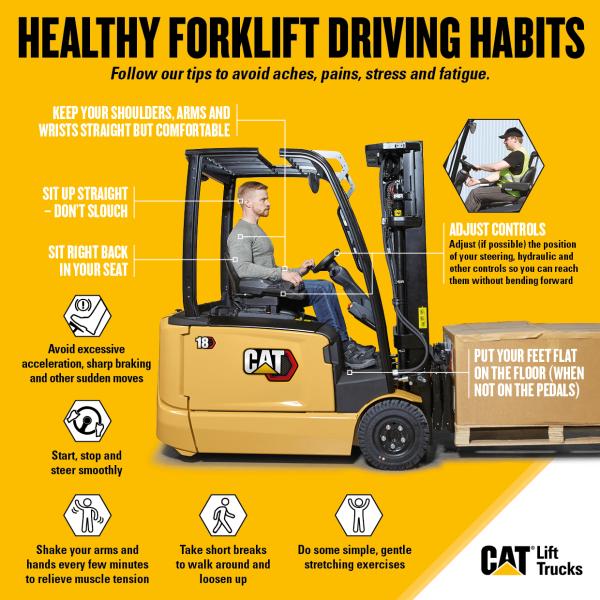
Strain-related problems – including repetitive strain injury (RSI) – typically cause pain in the back, neck, shoulders, wrists, arms or knees. They may result from a truck design that doesn’t allow a relaxed, strain-free posture. Worse still, the operator may have to keep twisting, turning or bending his or her neck and body. This may be necessary, for instance, to see past obstacles in the truck’s structure. Reaching and operating controls can similarly cause strains. Cramped cabin space and difficult entry and exit are further factors.
Vibration and noise are another important area of concern. High levels of whole-body vibration (WBV) are especially damaging to the operator’s back. Loud noises may damage the operator’s hearing. Even at lower levels, noise and vibration are annoying. When experienced day after day, the annoyance can build up into a serious issue. Operators feel tired, stressed and less fit for work.
Ergonomics in action: Cat® 1.6 to 2.5 tonne reach trucks
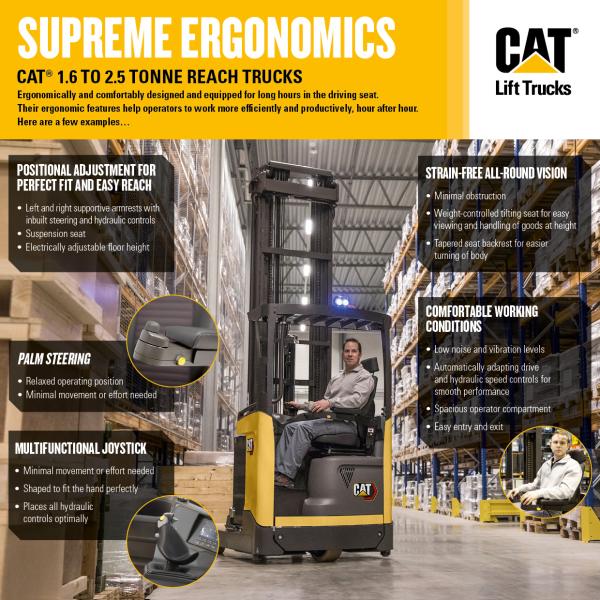
Our Cat® 1.6 to 2.5 tonne reach truck range gives a good illustration of how we address the issues above. It’s ergonomically and comfortably designed and equipped for long hours in the driving seat.
Steering and hydraulic controls are on positionally adjustable, supportive armrests. Operators can set these, along with the seat position, for easy reach. Electrically adjustable floor height is an additional aid to ensuring the perfect driver fit.
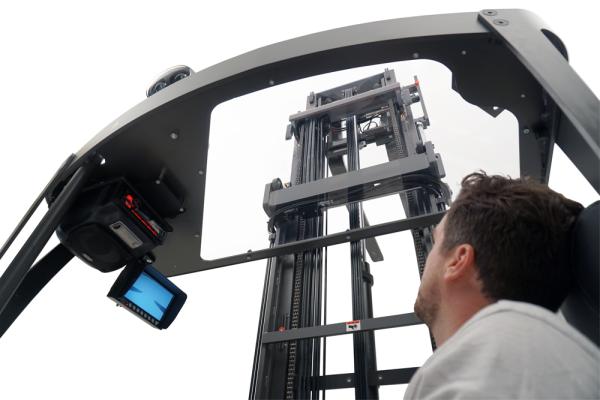
These trucks are designed with minimal obstruction to all-round vision. The suspension seat can tilt back by 18 degrees to reduce strain when viewing and handling goods at height. Its tilting is weight controlled. A tapered seat backrest enables easy turning of the body when necessary.
Our Palm Steering unit offers a relaxed driving position. It’s easy to operate with a minimum of movement or effort. The same is true for the multifunctional joystick, which is designed to fit the hand perfectly. It places all hydraulic controls optimally.
The spacious operator compartment allows plenty of foot, leg and head room. Entry and exit are smooth and easy, aided by grab handles and a low intermediate step. Low noise and vibration levels add to the driver’s comfort. Meanwhile, automatically adapting drive and hydraulic speed controls help to make every action smooth.
Click here for more information on these and all other ergonomically designed Cat warehouse and counterbalance trucks.
For further practical guidance on a wide range of topics relevant to materials handling, warehousing and logistics: