Your usage, diagnostics and servicing data hold the keys to keeping your forklift - and its parts - running longer.
Everywhere you look, forward-thinking businesses are leaning heavily into circular forklift thinking. And for good reason(s), including sustainability and profitability.
Achieving the biggest rewards in this area is about more than adopting a new way of thinking. That thinking needs to be grounded in facts and figures.
It needs to be a data-driven circular economy, according to Outi Kettunen, Director of Digital Services at Cat® Lift Trucks.
“The data-driven circular economy is a key area for both our organisation and our customers. We share a vision that the circular economy is one of the most impactful areas of sustainability. Data enables it with facts."
Data-driven circular economy in materials handling
Having access to the best data available allows operators to make the right decisions for their trucks - and their businesses.
Take servicing, for example. Rather than rely on log books and guesswork, the latest generation of Cat® lift trucks can equip providers with actual use data.
These insights into collisions, working hours and key component wear mean repairs and predictive maintenance are tailored to the machine. And this, alone, can prolong the life of your forklift and its parts.
Deep data also helps service providers to work more effectively. It guides engineers undertaking repairs, refurbishments and remanufacturing of lift trucks and their parts.
Batteries, for example, are a key truck component. They represent significant environmental and financial costs. Usage data allows us to help operators and service companies to make data-driven decisions, such as when to replace, repair or recycle.
Some benefits of adopting a data-driven circular economy last longer than others.
For manufacturers, harnessing usage data across huge fleets of machines allows us to look ahead. When designing new products, we can utilise real-world data to design new generations of products with even longer-lasting components.
The end of the road?
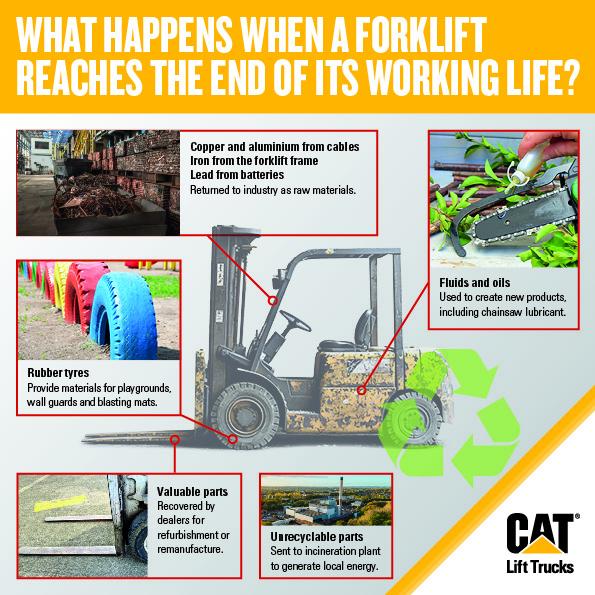
When a forklift truck eventually reaches its end-of-life, Cat Lift Trucks expects its dealers to recycle responsibly. The practical model for this varies between countries.
One of our European dealers has an interesting approach. It partners with a full-service recycling company.
After removing the forklift parts which Cat Lift Trucks wishes to refurbish or remanufacture, the lift trucks are handed over to specialised metal recycler NG Nordic.
NG Nordic is a leading Nordic provider of circular solutions and environmental services. They offer recycling and waste management services and sustainable secondary materials for reuse.
“When the forklifts arrive at our metal recycling plant, we first weigh them and check that their serial numbers and details match with our list of forklift trucks to be recycled,” says NG Nordic Sales Director Marcus Suokas. “Accurate records and data are essential in this sector.”
The first items in lift truck recycling to remove are potentially hazardous components, like batteries, engine and hydraulic oil, and fuels. Lead-acid batteries are sent to another specialist recycler for processing in Finland, while the recovered lead is returned to industry as a raw material.
NG Nordic has its own lithium-ion battery recycling solution. It also has an oil recycling plant which transforms used hydraulic fluid into new products, such as chainsaw lubricants.
Rubber tyres are sent to a scheme in Finland where they find a second life as material used in playground and artificial football pitch surfaces, wall guards and blasting mats.
Cables are then stripped out for processing in NG Nordic’s own plant. The resulting granulated copper and aluminium is then sold to smelting and manufacturing companies. In fact, a company neighbouring the factory uses some of the forklift recycling material to make aluminium frames for lamps.
The frame of the forklift is cut into factory-grade sizes for smelting into new iron.
Finally, the remaining forklift parts which cannot be recycled are sent to NG Nordic’s incineration plant. There, it generates heat and electricity for two cities.
Nothing is wasted.
The right forklift fleet tools for a data-driven circular economy
With so much to gain from the data-driven circular economy, we are committed to supporting the wider industry in maximising its operational efficiency.
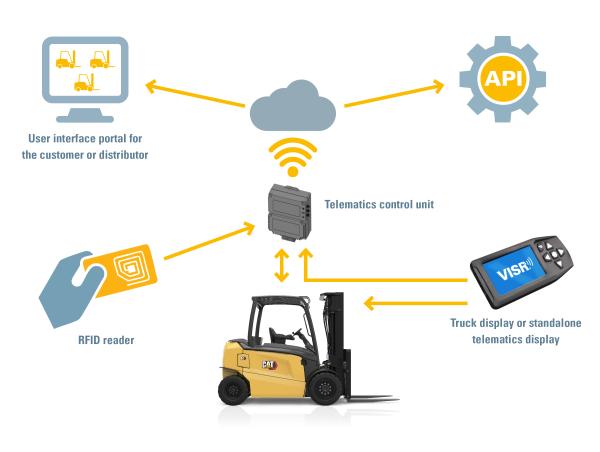
Our VISR integrated telematics solution provides operators and service providers with the data and insights necessary to optimise forklift management across a forklift’s lifecycle.
We have also developed a fleet management tool. It offers deep insights into servicing data and costs.
TruckTool, our diagnostics solution for field engineers, tracks and captures valuable machine data for analysis.
Looking ahead, work is already under way on a series of AI tools to help our field engineers work more effectively. As well as helping them diagnose issues, these tools will guide them on repairs and part replacement, too.
For further practical guidance on a wide range of topics relevant to materials handling, warehousing and logistics: